Designing Healthcare Environments Starts With How People Feel
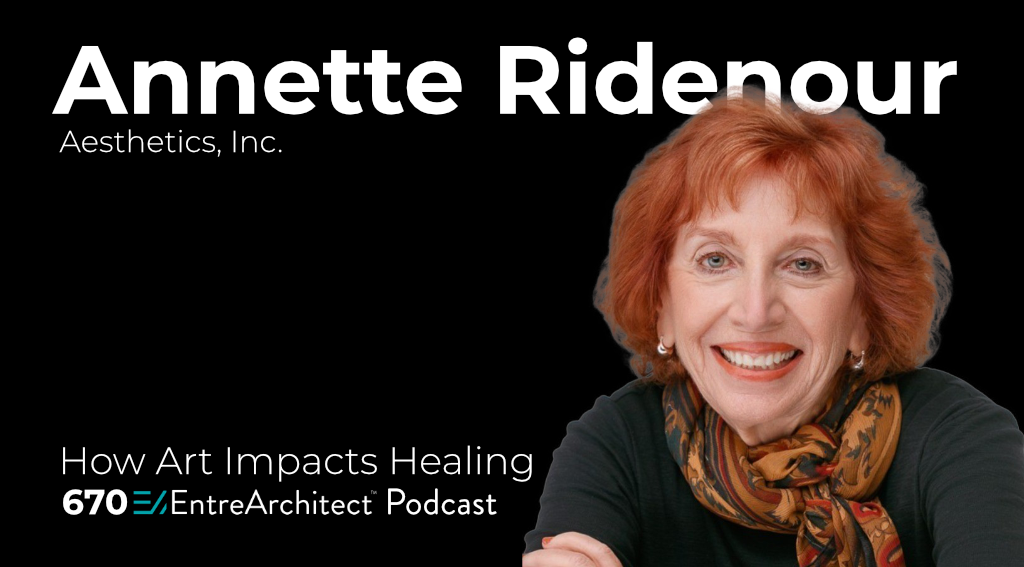
Annette Ridenour learned what a room can do to a person when caring for her ailing mother. It was the kind of clinical space that was built for function and little else, the sort of environment that offered nothing for a person to hold onto during a hard stretch of their life. Green paint. Sterile walls. Fluorescent lighting. Rather than accept that as the way things had to be, she saw an opportunity in it. If a room could leave a person feeling worse, then a room could also help a person feel better, and someone had to design for that. She came away understanding something that has driven her work ever since. A space is never just a container for care. It is part of the care, or it is working against it.
She built a firm on that idea and spent more than four decades proving it. Her insight belongs to every architect who has ever wanted their work to matter beyond the walls it draws. No environment is neutral. Look at any building, she told me, and it is either contributing to health and well-being or preventing it. There is no third option, and once you accept that, you cannot design the same way again.
Art That Does Work
Some think of art in a building as decoration. Something pleasant. The line item that disappears first when the budget tightens. Annette’s entire practice is a refusal of that assumption.
The difference she draws is between hanging artwork and curating an art program. One fills a wall. The other is a deliberate act where every choice carries a reason, and the reason holds up under scrutiny. The right curation of art can lower stress, reduce cortisol, calm the nervous system, and steady a frightened mind. She was doing this on instinct in 1980, before there was any research to point to. The science has since caught up to what she felt in that hospital room.
Scale does not change the mechanism. One considered piece in a small waiting room does the same quiet work as a program spanning a hospital campus. What matters is whether the choice was made with intention or left to chance.
From Instinct to Authority
The deeper lesson in Annette’s story reaches past art entirely. She took a feeling and turned it into evidence, and the evidence into authority.
Early on, all she could say was that a space felt better. Now she can name why. She talks about biophilia, the way we relax in the presence of nature. She talks about belonging, and the research showing that people feel more at home when a space reflects their own community and story. That is what evidence gives an architect. Not only a better outcome, but a language clients trust. When you can explain why a decision matters, in terms a client feels and a budget committee respects, you are no longer defending taste. You are offering expertise. And expertise survives the value-engineering conversation that taste never does.
The Places No One Photographs
For years, healthcare design spent its budget on first impressions. The lobby. The atrium. The wide welcoming entry. Annette moves in the other direction, toward the rooms where fear actually lives. The treatment spaces. The imaging rooms. The place where a patient waits alone in a paper gown, or a child sits before a procedure, or a family hears news that changes everything.
These rooms never make the portfolio photograph. They are where design matters most, because they hold people at their most vulnerable. And Annette widens the circle further still, to the people who work there. She has walked staff spaces in older facilities and found them neglected in ways that would shame the public front of the same building. We are living through a real crisis of burnout among physicians and nurses, and the environment they move through all day is part of that story. When a caregiver arrives depleted, the patient feels it. Designing for the whole person means designing for everyone the building holds.
Intention Is the Thing They Cannot Cut
This is what stays with me from the conversation. Budgets get cut. That is a permanent condition of the work, and no amount of conviction changes it. But intention has no line item. It cannot be reduced, deferred, or engineered out of a project. It is the one thing you bring to the table that no client can take away.
Annette’s advice to architects was simple, and it landed exactly where the whole conversation had been pointing. Bring the strongest possible intention to every project, however small, because every project shapes the whole human experience of the people who live inside it. That is not a philosophy reserved for the grand commission. It is a decision available on the most ordinary job you will take this year.
Nothing you design is neutral. Nothing you build is harmless. Every choice about light and space and finish is doing something to someone. The only question worth asking is whether you decided what that something would be. Decide. Then design like you mean it.
Listen and Go Deeper
Annette Ridenour has spent more than forty years proving that the spaces we design change how people heal. Her perspective on curation, community, and whole person design will change how you see your next project. Listen to the full conversation on the EntreArchitect Podcast at https://entrearchitect.com/670.
And if you are ready to build a better firm alongside small firm entrepreneur architects who take this work as seriously as you do, join us in the EntreArchitect Network at https://entrearchitect.com. The business of architecture is hard to navigate alone. It is better when you walk it with people who understand the road.

Leave a Reply