Why serving your community builds the trust that wins work, and why that trust is the one thing AI can’t replicate.
Most small firm architects I talk to carry the same quiet worry. They are good at the work. They can design a beautiful, functional, durable building. What keeps them up at night is where the next project comes from. So they do what they think business development requires. They build a slick website, they enter awards, they post the finished photography, and they wait for the phone to ring. Then they wonder why it stays quiet.
If you have ever felt that low-grade dread about how architects get clients, I want to offer a different way to think about it. The firms that win consistent, good-fit work are rarely the ones shouting the loudest about being award-winning. They are the ones people already know, already trust, and already think of when a problem shows up. That trust is not built through marketing. It is built through showing up.
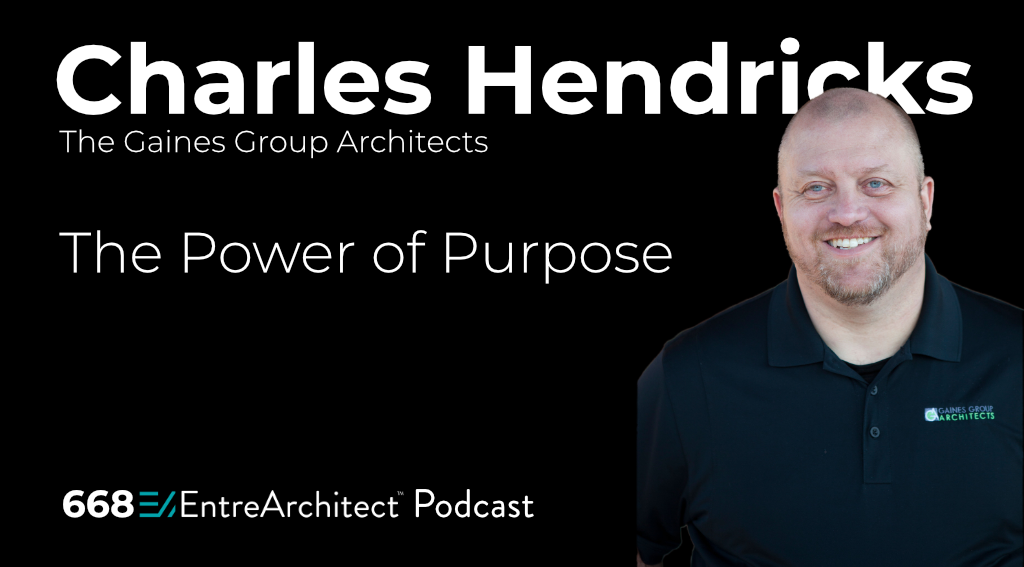
I was reminded of this in my conversation with Charles Hendricks, CEO of the Gaines Group Architects, who has spent nearly three decades building a purpose-driven firm in Virginia. Charles said something that stopped me. The only way he has ever found to sell architectural services is to build trust. Not to pitch. Not to persuade. To be invested in a community so visibly and so genuinely that when someone has a question, you are the person they call.
That is a reframe worth sitting with. Getting clients is not a selling problem. It is a trust problem. And trust is earned in a completely different currency than the one most of us are trying to spend.
The Marketing You Are Doing May Be the Wrong Work
Here is the trap. When work slows down, the instinct is to market harder. More posts, more polish, more proof that you are excellent. The message underneath all of it is some version of “we are the best award-winning architects, hire us.”
Charles named the flaw in that approach plainly. You can win every award and still be invisible. If people never see you anywhere, if you are not present in the life of your community, then all that marketing says is “we are here if you need us.” That is a passive position. It waits for demand instead of creating relationships that generate it.
The alternative is not more marketing. It is more presence. When you are genuinely part of a community, doing good and visible work inside it, three things happen in sequence. People come to know you. Then they come to like you. Then, when they face a problem you can solve, they call you before they call anyone else. You have not sold anything. You have simply become the obvious choice.
This is the part that trips up analytical minds, and architects tend to have analytical minds. Presence feels inefficient. It does not map neatly to a lead or a line item. But it is precisely the work that compounds, and it is the reason some firms never seem to struggle for the right kind of client while others chase every opportunity that moves.
Service Is an Investment, and Investments Have Returns
I pushed Charles on this, because I think we have to be honest about the business side. If you give all your time away, you can serve yourself right out of business. Generosity without discipline is not stewardship. It is a slow leak.
Charles was clear-eyed about it. He talks about community involvement as an investment, and an investment implies a return. His firm does pro bono work, he serves on boards, he shows up. And the firm gets a steady stream of opportunities it would never see otherwise, work that arrives through reputation rather than pursuit. The return is real. It is just not immediate, and it is not why he starts.
That distinction matters. If you volunteer only to extract leads, people feel it, and the trust never forms. But if you serve because you care about the place you work in, and you do it consistently, the business result follows as a byproduct. The trick is to hold both truths at once. Give sincerely, and still be intentional about your time, because a firm that cannot pay its people cannot serve anyone.
One project Charles described captures the whole idea. Habitat for Humanity handed him a narrow, difficult lot in a floodplain, a site their standard duplex designs could not fit. He solved the puzzle, but he did more than solve it. Instead of two separate entrances and two separate porches, he ran the deck across the full facade and set a bench under a pergola in the middle, a bridge between the two front doors. He designed the two families into knowing each other. Habitat, which almost never spends extra on anything, chose to build it, because they understood those neighbors would form a bond and stay. That is design thinking as community building. And it is exactly the kind of work that makes a firm unforgettable in the place it serves.
Trust Is the Moat AI Cannot Cross
There is an anxious question running underneath a lot of small firm conversations right now. Will AI replace us? Charles gave the most grounded answer I have heard.
AI may become a tool that enhances what you do. It will not replace the thinking that sits at the center of good architecture, because that thinking runs on empathy, experience, and relationships. A model has none of those. It has not sat across the table from a client and understood a fear they could not quite articulate. It has not walked a hard site and felt what the neighborhood needed. Charles put it directly. Empathy is the most powerful design tool you have, and it is the one thing that cannot be automated.
This connects straight back to how architects get clients. The commodity work, the low-price drafting, the standard plans stamped and shipped, is the work most exposed to automation. A developer once told Charles he charged too much and would only be called when a creative solution was needed. Charles’s read was that the cheap, drafting-only firm is exactly the one AI will replace. The firm that survives and thrives is the one known for judgment, empathy, and problem solving that no tool can reproduce.
So the community strategy is not just a way to get work today. It is a way to build the exact reputation that keeps you relevant as the profession changes. Every board you serve on, every problem you solve in public, teaches your community that design matters and that a thinking human is the reason it matters. You are not only earning trust. You are defending the value of the profession itself.
Where to Start This Week
If this resonates but you do not know where to begin, Charles offered practical on-ramps that any small firm entrepreneur architect can take, and none of them require a marketing budget.
Start where service and relationships already gather. Boards and commissions are perpetually looking for people willing to give their time and their thinking, and a mind trained to see problems differently is a gift in those rooms. Charles pointed to Rotary as one place he has plugged in, not for the networking in the transactional sense, but for the weekly rhythm of building real friendships with other service-minded people who then amplify the good you are doing. Visit a few clubs until you find the one whose people and schedule fit your life.
Then invest in the next generation, which Charles believes is the single most impactful thing you can do for your business over time. Call a school counselor and offer to talk with students who are curious about architecture, because every high school has one or two and almost none of them have a real connection to the profession. Set up at a career day. Bring on a college intern and hand them real design work, not a bathroom detail, and watch how much you learn from them in return. Charles has had thirty-five or so students move through his office over the years, and even the ones who never come back go out into other firms asking better questions and pushing the work forward.
None of this is a campaign. It is a practice. It is the patient, intentional building of a reputation that makes selling unnecessary, because the trust does the work for you.
The firms that will still be standing, and still be needed, a decade from now are the ones building that trust today. That is how architects get clients without selling. Not by pitching harder, but by becoming so woven into the life of a community that the work finds you.
To hear Charles’s full story, including how a dyslexia diagnosis he now calls a superpower shaped his entire approach to design and service, listen to the full episode at https://entrearchitect.com/668.
And if you want to build a better firm alongside architects who are doing this work with intention, join us in EntreArchitect Network at https://entrearchitect.com. We would be glad to walk with you.

Leave a Reply