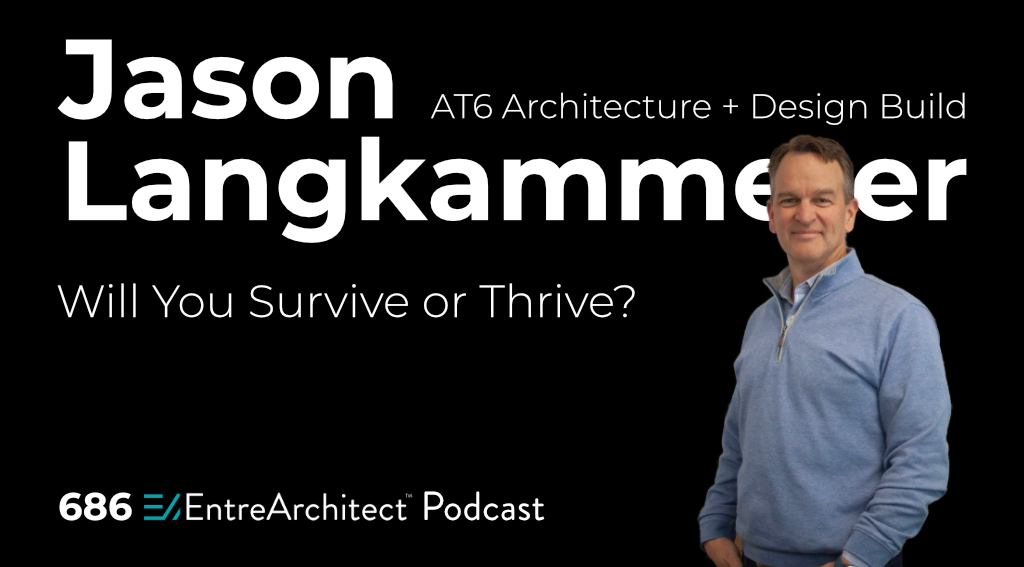
Jason Langkammerer’s path to architect-led design build shows what it takes to stop surviving on talent alone and build a firm that thrives.
I have read The E-Myth Revisited more than a dozen times. I have given away at least that many copies, usually to an architect who had just told me some version of the same story: they were tired, they were busy, and the firm they built to give them freedom had become the job they couldn’t leave. Every time I pick the book up, a different chapter speaks to the season I’m in. This time it was the beginning, the part Michael Gerber calls the entrepreneurial seizure. If you are looking for the E-Myth for architects in a single idea, this is where I would start, because almost every small firm I have worked with was born in one.
The seizure is the moment a skilled technician looks at the person they work for, or the person they work alongside, and thinks: I can do this myself. Why am I making money for someone else? It feels like courage. It feels like clarity. Gerber’s warning is that it is usually neither. It is the start of a long and expensive lesson.
The Moment Every Small Firm Owner Remembers
I recently sat down with Jason Langkammerer, licensed architect and general contractor, and founder and president of AT6 Architecture + Design Build in San Francisco. Jason told me about his seizure so precisely that I named it for him on the spot.
It was 2010. The recession had emptied his pipeline, his co-founder had moved back east, and Jason was framing a couple of days a week for a friend just to keep the doors open. His firm had one small bathroom remodel in Marin County, built by an outside contractor. When the crew opened a wall, they found an old hold-down that had been installed crooked, sitting proud of the framing. The contractor wanted to tear out and reframe the wall. Jason knew how a hold-down works. Loosen the nut, slip a shim behind it, retighten. Problem solved in minutes.
Standing in that bathroom, he realized he didn’t need someone else to build his designs. He could do it. That is the entrepreneurial seizure in its purest form, and I suspect you have your own version. Maybe it was a principal who mishandled a client you knew you could have kept. Maybe it was a fee you watched someone else collect for work you did. The details change. The feeling does not.
The E-Myth for Architects Begins With the Fatal Assumption
Gerber’s most important insight, the one I would underline if I could only underline one, is what he calls the fatal assumption. Paraphrased simply, it is the belief that because you understand the technical work of a business, you understand how to run a business that does that work.
Architects are especially vulnerable to this. We spend years learning to design, to detail, to coordinate consultants, to solve problems no one else in the room can see. That expertise is real, and it is hard won. But it is the expertise of what Gerber calls the Technician. A firm also needs an Entrepreneur who holds the vision and a Manager who builds the order that makes the vision repeatable. Most of us start our firms with only one of those three fully developed, and we assume the other two will show up when we need them.
They don’t. What shows up instead is the work, all of it, landing on the desk of the one person who knows how to do it.
Jason’s hold-down moment was a technician’s insight. It proved he could build. It did not prove he could build a business that builds. What happened next is the part of the story I find most instructive for small firm entrepreneur architects, because it followed Gerber’s script almost exactly.
Surviving Is Not the Same as Building a Firm
For years after that moment, Jason took whatever came through the door. Design only, with someone else’s contractor? Sure. Build only, from someone else’s drawings? He would talk to you. Design build? Of course. He even carried a crew of carpenters for a time and took on projects he didn’t want simply to keep them busy.
None of that was a mistake in the moment. When the pipeline is thin, you eat what is on the plate. But Jason described it with real honesty as a firm that was surviving, not thriving, and he was clear that the difference came down to one discipline: saying no to the work that didn’t fit what would make the firm thrive.
This is the technician’s trap. When every project is different, every project requires you. Each new delivery method brings its own contracts, its own expectations, its own way of handling a mistake in the drawings. There is no system, because there is nothing consistent enough to systematize. The owner becomes the system, and the owner can only stretch so far.
I have watched hundreds of small firm owners live inside this pattern for a decade or more. They are talented, they are working hard, and the firm still depends entirely on them. That is not a failure of effort. It is the fatal assumption playing out in real time.
What Changed When Jason Chose One Way to Work
About ten years ago, Jason made the decision that, in his words, was the best business decision he ever made. AT6 became design build only. They design what they build, and they build what they design. Nothing else.
He was candid that this still costs him. Beautiful projects arrive with a family member already lined up to build. Construction-ready projects arrive with a design team attached, at the exact moment the schedule has a gap. He turns them down anyway.
What that single choice made possible is the Manager’s work Gerber describes. Once there was one way to deliver a project, there could be one process for delivering it, and that process could be refined over and over. Jason walked me through how it runs. Every engagement begins with a feasibility study, really a scoping and budgeting phase, priced on the same granular estimating spreadsheet he uses for the final construction estimate. Counting towel bars and linear feet of tile base at the earliest stage is how he gives clients a realistic, all-inclusive number before they fall in love with a design they can’t afford. The contracts follow a defined sequence of signatures, each one a clear gate, ending with a fixed construction price before work begins. Each project has one dedicated superintendent. The roles are clear.
That is what a business looks like when it is built to be repeated rather than reinvented. The process carries the knowledge, so the owner doesn’t have to carry it alone. Jason also told me that over twenty years he has sold roughly the same number of projects, yet adding construction has grown revenue more than tenfold. Focus didn’t shrink the firm. It changed what each project could become.
Why You Can’t Simply Step Out
There is one more piece of Jason’s story that belongs in any honest conversation about the E-Myth for architects, because it is where many firm owners stumble even after they understand the book.
A few years ago, trying to grow, Jason pulled himself out of the day-to-day and handed the running of projects to others. It didn’t work. The attention to client care slipped, and the firm stopped finishing projects with clients eager to tell their story. He responded by putting the right people in the right seats and deliberately shrinking a little, so he stayed close enough to the work to protect the experience. The last few years, he said, have been one happy client after another.
Gerber would recognize this immediately. Working on your business rather than in it does not mean walking away from the work. It means building the systems and developing the people so that your standards live in the firm and not only in your head. Step back before that foundation exists, and the quality you built your reputation on leaves the room with you. The path out of the technician’s role runs through the Manager’s role, and there are no shortcuts around it.
Building a Firm That Works Without You
Jason’s current initiative brings the whole arc together. He calls it Project Legacy 2040. The year marks the latest point he wants to be working, but the goal is not a sale. The goal is a company that no longer runs through him as the access point to everything, where people who raise their hands get mentorship and a real path toward leadership, and where even those who never want ownership gain responsibility because of the way the firm is structured.
That is the end of Gerber’s argument. The entrepreneur builds a business that works without the entrepreneur, not to escape it, but so it can serve clients and the team long after the founder steps away. It is stewardship in its fullest sense.
Your Next Step Toward a Better Firm
You have likely already had your entrepreneurial seizure. You may be living inside the fatal assumption right now, doing excellent work and wondering why the firm still can’t run for a week without you. Both are normal. Neither is permanent.
Start with one honest question: where does every project in your firm still depend on you to decide, fix, or approve? Then make one decision that narrows the work, the kind of decision that lets a process take shape. You don’t have to change everything tomorrow. Jason survived for years before he knew what thriving meant for his firm. But each choice rooted in clarity moves you closer to a business that serves your life rather than consuming it.
Listen to my full conversation with Jason on the EntreArchitect Podcast at https://entrearchitect.com/686.
Then join the EntreArchitect Network at https://entrearchitect.com, where small firm architects are building better firms together.

Leave a Reply