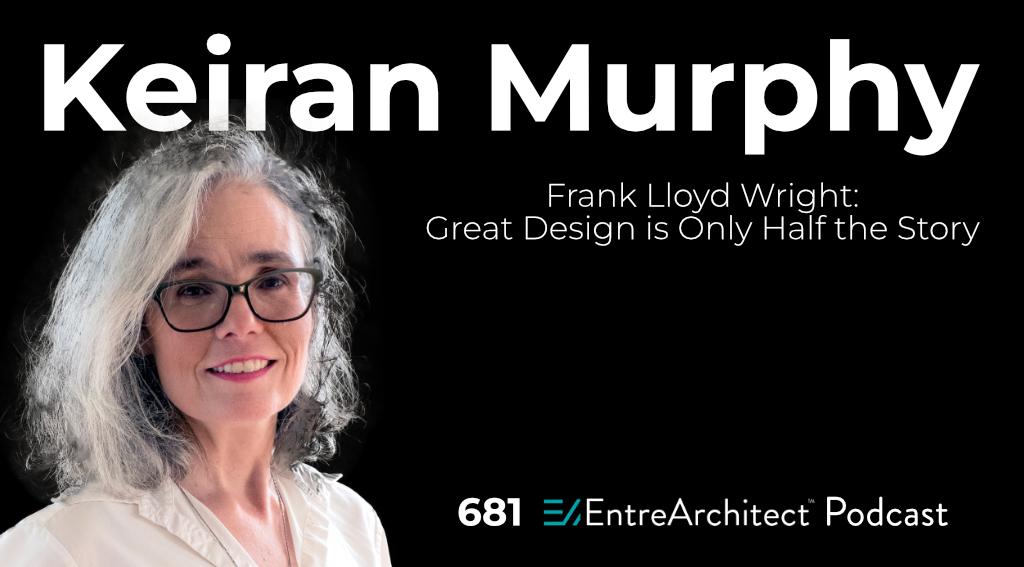
What one of architecture’s greatest innovators can teach us about entrepreneurship, professional success, and building a sustainable practice.
We spend years studying the work of great architects. We examine their buildings, analyze their design philosophies, and learn how their ideas influenced the profession. Frank Lloyd Wright is among the most studied architects in history, and for good reason. His contributions fundamentally changed the way we think about buildings and their relationship to the world around them.
But there’s another side of Wright’s career that receives considerably less attention. Beyond his extraordinary architectural accomplishments, he was an entrepreneur who spent decades exploring different ways to practice architecture, educate future architects, and bring his ideas into the world.
I’ve occasionally joked that Frank Lloyd Wright was one of the original EntreArchitects. The more I learn about his career, the more interesting that observation becomes. Wright demonstrated remarkable entrepreneurial imagination, yet his professional life also included financial struggles and complicated business relationships.
That contrast raises an important question for those of us who own architecture firms today. What does it really mean to be a successful architect, and how does that differ from building a successful architecture business?
The Architect Behind the Legend
This past June, I returned to Taliesin in Spring Green, Wisconsin, with members of the EntreArchitect Community. During our visit, we spent time with architectural historian Keiran Murphy, who has devoted decades to researching Wright’s life and work at the estate.
I recently invited Keiran to join me on the EntreArchitect Podcast. Our conversation explored a side of Wright that is often overshadowed by his reputation as an architectural genius.
Keiran described the difference between the mythology surrounding Wright and the realities of his life. He was confident, ambitious, and willing to challenge established conventions. But he was also a complicated individual whose decisions sometimes created difficulties for himself and the people around him.
Taliesin offers a particularly revealing perspective on his approach to architecture. Wright began building the estate in 1911 and continued modifying it throughout his life. Beyond the reconstruction required after devastating fires, he repeatedly experimented with spaces, materials, and structural ideas.
Some experiments produced extraordinary results. Others created problems that remain challenging for the people responsible for preserving the buildings today.
Keiran explained that Wright’s confidence in his architectural ideas sometimes exceeded the practical realities of construction. His intentions were ambitious, but the results weren’t always predictable.
I think that’s an important distinction when we consider the relationship between architectural creativity and professional responsibility. The ability to imagine something extraordinary is valuable, but bringing that vision into reality requires judgment, resources, and an understanding of the consequences.
For an architect who owns a business, those responsibilities extend far beyond the buildings we design.
Frank Lloyd Wright, the Entrepreneur
Wright’s entrepreneurial ambitions extended well beyond traditional architectural commissions.
In 1932, he and his wife, Olgivanna, established the Taliesin Fellowship. The program brought apprentices into an immersive educational environment where architectural study was integrated with communal living, construction, maintenance, and participation in Wright’s practice.
It was an unconventional model that allowed Wright to develop future architects while creating a community organized around his architectural philosophy.
His approach to residential architecture also reflected entrepreneurial thinking. Through his Usonian houses, Wright explored ways to make thoughtfully designed homes more accessible to middle-income Americans. His later Usonian Automatic system incorporated modular concrete blocks and opportunities for homeowners to participate in construction.
He also pursued commercial relationships that extended his design work into manufactured products, including textiles and furnishings.
These efforts demonstrate something worth recognizing. Wright understood that an architect’s ideas could create value beyond the conventional exchange of professional services for fees.
Today, architects have opportunities to apply that same entrepreneurial thinking in ways appropriate to their own practices. Specialized consulting, educational programs, product development, and other complementary services can create additional sources of revenue while extending the impact of an architect’s expertise.
But there’s an important qualification.
Not every good idea is a good business opportunity. Developing additional services requires an understanding of the market, the resources necessary to deliver them, and whether they contribute to the firm’s long-term financial health.
Entrepreneurship isn’t simply about finding more ways to generate revenue. It’s about creating value through a business model that can sustain itself.
When Architectural Vision Meets Financial Reality
For all his creative accomplishments, Wright’s career included recurring financial difficulties. His relationships with clients and supporters were sometimes complicated, and his ambitions occasionally exceeded the resources available to support them.
During our conversation, Keiran discussed Wright’s relationship with Darwin Martin, the Buffalo businessman who commissioned one of his most celebrated residential projects. Martin also provided Wright with substantial financial assistance over the years, illustrating how closely personal relationships, professional opportunities, and financial circumstances could become intertwined.
We should be careful about drawing broad conclusions from individual episodes in Wright’s life. He practiced through periods of significant economic instability, and his financial circumstances changed considerably throughout his long career.
Nevertheless, the distinction between creative achievement and financial sustainability deserves our attention.
I’ve worked with many architects who have built impressive portfolios, developed strong reputations, and established firms that appear successful from the outside. Yet behind those accomplishments, some struggle with inadequate profitability, unpredictable cash flow, and the constant pressure of keeping their businesses operating.
The problem isn’t necessarily a lack of work or professional ability. Often, it’s that the architect has devoted far more attention to developing their craft than to developing the business that supports it.
Architects deserve to be compensated appropriately for the value they create. They deserve businesses that provide financial stability, opportunities for their employees, and the freedom to make decisions based on their professional values rather than immediate financial pressure.
Achieving those outcomes requires more than architectural talent.
It requires understanding the economics of practice, establishing profitable fees, managing resources responsibly, and developing systems that allow the business to operate effectively.
Creative ambition and financial discipline are not competing priorities. A sustainable business provides the foundation that allows ambitious architecture to happen.
The sequence is, profit, then art.
How Should We Measure Success?
Architecture has a long tradition of celebrating individual achievement. We recognize architects through awards, publications, prestigious commissions, and the influence of their work.
Those accomplishments matter. They advance the profession and demonstrate what architecture can contribute to society.
But for an architect who owns a firm, professional recognition represents only one dimension of success.
What about the financial health of the business? The opportunities created for employees? The relationships developed with clients? The owner’s ability to spend time with family, pursue personal interests, and enjoy the life they’ve worked to build?
These considerations are rarely part of the conversation when we study the careers of celebrated architects.
Yet they are central to the decisions small firm owners make every day.
I’ve known architects who intentionally maintain small practices because they value direct involvement in design and the flexibility that comes with controlling their schedules. I’ve also worked with owners who want to build larger organizations, develop future leaders, and establish firms that can continue beyond their personal involvement.
Both approaches can lead to successful, fulfilling careers.
The important distinction is whether the business supports the owner’s definition of success.
Too often, architects build firms around the opportunities that come their way without taking time to consider what they ultimately want those businesses to become.
They accept projects, hire employees, expand services, and take on additional responsibilities. Eventually, they discover that they’ve created organizations that demand more time and energy than they intended to give.
A successful architecture firm should be designed with the same intentionality we bring to our buildings.
We begin a project by understanding the client’s goals, evaluating constraints, and establishing priorities. We should approach our businesses with similar discipline.
What kind of work do you want to create? What financial results must your firm achieve? What responsibilities do you want to retain, and which should eventually belong to others? What role should your business play in the life you want to lead?
The answers will be different for every architect, but those answers should guide the decisions we make about our firms.
Building a Practice Worth Building
One of the most valuable aspects of my conversation with Kieran was the opportunity to consider Frank Lloyd Wright as a human being rather than simply an architectural icon.
His extraordinary accomplishments deserve recognition. So does his willingness to challenge conventional thinking and explore new possibilities for architecture.
But we don’t need to adopt every aspect of his professional approach to appreciate his contributions.
As entrepreneur architects, we can admire his creative ambition while recognizing that our own success requires a broader set of responsibilities.
We must develop our abilities as designers, but we must also learn to lead people, manage resources, establish meaningful client relationships, and build organizations capable of supporting our ambitions.
Those skills deserve the same attention and commitment that we devote to architecture itself.
I encourage you to consider how you currently measure success in your own practice. Look beyond your portfolio and the projects you’re pursuing. Examine whether your business is producing the financial results, professional opportunities, and personal fulfillment you intended when you established it.
If there is a gap between where you are and where you want to be, identify one meaningful change you can begin making today. Perhaps that means improving your understanding of your firm’s finances, developing a stronger leadership team, or reconsidering the types of projects you pursue.
The objective isn’t to build a business that looks like someone else’s definition of success. It’s to create a practice that supports the architecture you want to produce and the life you want to live.
Frank Lloyd Wright left an extraordinary architectural legacy. His career also gives us an opportunity to consider the difference between creating remarkable buildings and building a successful practice.
Architecture is what we create. Our business is what makes that creation possible.
When we build financially sustainable, well-led firms, we create greater opportunities to pursue meaningful work, support the people who depend on us, and contribute to the communities we serve.
That’s why I believe better business creates better architecture. And that’s why the business of being an architect deserves as much attention as the architecture itself.
For a deeper exploration of Frank Lloyd Wright’s life, his entrepreneurial ambitions, and the remarkable history of Taliesin, I invite you to listen to my conversation with architectural historian Keiran Murphy on EntreArchitect Podcast Episode 681.

Leave a Reply