Why the projects you choose, the clients you accept, and the red flags you recognize may protect your architecture firm more than insurance ever can.
Risk Management Starts Before You Sign the Contract
Most architects think about risk management after they have already decided to take the project.
We think about our contracts. We think about professional liability insurance. We worry about documenting decisions, managing consultants, responding to RFIs, and protecting ourselves during construction. Those are all important parts of risk management for architects, but they happen relatively late in the process.
Some of the most important risk management decisions happen before there is a project.
They happen when the phone rings.
Is this a client we want to work with? Is this a project we should pursue? Are the expectations reasonable? Does the fee support the work required? Are there warning signs we are choosing to ignore because we really want the commission?
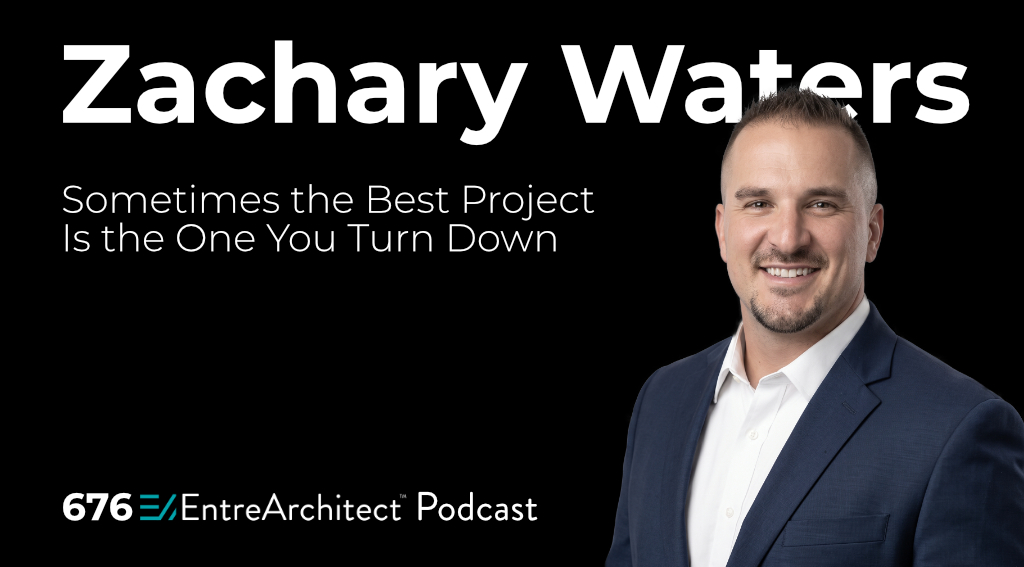
I recently had a conversation with my longtime friend Zachary Waters, Managing Principal at Black Swan Insurance Services, for EntreArchitect Podcast Episode 676. Zach has spent years helping architects and engineers understand professional liability, insurance, and risk management. During our conversation, he made an important distinction that every small firm architect should understand.
Fault and exposure are not the same thing.
That distinction changes the way we should think about risk.
Being a Good Architect Does Not Eliminate Your Exposure
Architects tend to think about professional liability in terms of mistakes.
If I produce good drawings, communicate clearly, perform my services professionally, and meet the standard of care, I should be protected. Certainly, doing good work reduces our risk, but it doesn’t eliminate our exposure.
You can do everything right and still find yourself involved in a claim.
A dispute may involve the contractor, structural engineer, owner, developer, manufacturer, or any number of other parties. An attorney may name everyone connected to the project. The claim may ultimately prove to have nothing to do with your services, but you still need to respond, defend yourself, produce documents, talk with attorneys, and spend time dealing with the situation.
Zach compared it to driving a car. You may be an excellent driver. You may follow the speed limit and pay attention to everything happening around you. That doesn’t eliminate your exposure because you are sharing the road with everyone else.
Architecture works the same way.
The larger and more complicated the project becomes, the more people are involved. Construction values increase. Expectations increase. Contract requirements become more complicated. Clients may have attorneys involved from the beginning. All of those factors can increase your exposure regardless of the quality of your architecture.
This is why risk management for architects cannot simply be about avoiding mistakes.
It needs to include choosing the right circumstances in which to practice.
Some of My Most Profitable Projects Were Projects I Never Accepted
During my years practicing architecture, I learned to recognize red flags.
Unfortunately, I learned many of them the hard way.
A difficult client teaches you something about the next prospective client. A project that slowly expands beyond the original scope teaches you what needs to be clarified in the next agreement. A client who refuses to respect your process teaches you what questions to ask before accepting the next commission.
Eventually, you begin to recognize patterns.
I remember opportunities that looked fantastic from the outside. They were the kinds of projects architects dream about. Interesting sites. Great budgets. The potential for beautiful photographs and a project that would strengthen the portfolio.
But something didn’t feel right.
Then there would be a red flag.
And another.
And another.
At some point I learned that the architecture wasn’t enough to justify the risk. I had to walk away.
Looking back, I sometimes say that a few of the most profitable projects I ever had were the projects I never accepted. I didn’t earn a dollar from them, but I also didn’t spend two years fighting unrealistic expectations, chasing unpaid invoices, defending scope, or lying awake at night worrying about a client relationship that had gone wrong.
Avoiding a bad project has value.
We rarely calculate that value because it doesn’t appear on the income statement. But the opportunity cost of a bad client can be enormous.
Build a Go/No-Go System for Your Firm
Zach recommends that architects develop a go/no-go process for evaluating prospective clients and projects.
I agree.
The important word there is process.
Too many small firm architects make these decisions based on instinct alone. We meet someone, get excited about the project, start imagining the design, and suddenly we are emotionally invested in winning the work.
That is exactly when we need a system.
Your go/no-go criteria will be different from mine because every architecture firm is different. A residential architect designing custom homes has different risks than a firm designing multifamily developments or municipal projects. Your market, experience, financial position, team, and goals should influence the criteria you use.
But there are some questions every firm can ask.
Is this the type of project we are qualified and experienced to deliver successfully? Does the client understand what architects actually do? Are expectations about schedule, budget, and services reasonable? Does the client respect our process? Is the proposed fee appropriate for the work and risk involved? Are the contract requirements reasonable? How will consultants be managed? Does the client have a history that concerns us? Is there anything about this opportunity that we are already trying to explain away?
That last question matters.
When we really want a project, we become remarkably talented at explaining away warning signs.
Don’t.
If you find yourself repeatedly saying, “I’m sure that won’t be a problem,” pay attention.
Not Every Warning Sign Means You Walk Away
A go/no-go system does not mean rejecting every project that isn’t perfect.
Perfect projects don’t exist.
Zach made a useful distinction during our conversation between red flags and yellow flags. A yellow flag may simply identify something that needs additional investigation, clarification, or negotiation.
Perhaps the client’s payment history concerns you, but they have a long-term relationship with your firm and a substantial pipeline of future work. Maybe the proposed contract contains language you cannot accept, but the client is willing to negotiate it. Perhaps the project type is slightly outside your normal work, but you can assemble a consultant team with the required experience.
Those are business decisions.
The purpose of a go/no-go process isn’t to eliminate risk. That would be impossible. The purpose is to make risk visible before you accept it.
Once the risk is visible, you can decide whether the potential reward justifies the exposure and what you need to do to manage it.
That is a very different decision from discovering the risk six months after signing the agreement.
Your Agreement Is Part of the Risk Management System
Once you decide that the client and project are right for your firm, your agreement becomes one of your most important risk-management tools.
Zach recommends having a standard agreement that you understand and use consistently.
That doesn’t mean downloading a contract from somewhere and changing the project name.
You need to understand what the agreement actually says.
Your agreement should clearly define your scope, compensation, responsibilities, and the responsibilities of your client. Depending on your practice and the project, it may need appropriate limitation-of-liability provisions and other risk-management language. You should also have a process for subconsultant agreements, additional services, amendments to scope, and situations such as requests for electronic documents.
The specific language should be reviewed by the appropriate professionals for your firm and jurisdiction.
The bigger lesson is that the contract should reflect how you actually operate.
When the scope changes, document it. When the client asks for additional services, address them. When responsibilities become unclear, don’t allow ambiguity to become the operating procedure for the project.
Small problems become large problems when nobody stops to clarify them.
Insurance Is the Backstop, Not the Strategy
Professional liability insurance is essential protection for an architecture firm, but buying insurance isn’t the same thing as practicing good risk management.
Zach explained that a $1 million professional liability limit is a common starting point for many architecture firms, particularly because commercial contracts frequently require at least that amount. He also pointed out something architects sometimes overlook: defense costs may be inside the policy limit, depending on the policy, and those costs can consume a significant portion of the available coverage.
But the larger point from our conversation wasn’t how much insurance to purchase.
It was how to avoid needing it.
The best insurance relationship isn’t simply a company that sends you a policy once a year. The right insurance and risk-management team can become part of your advisory team, helping you understand contract requirements, evaluate unusual situations, and recognize exposure before it becomes a claim.
That changes insurance from an annual expense into a business resource.
The goal should be to practice architecture for decades and never need your professional liability policy to defend a serious claim.
You Cannot Be the Expert at Everything
One of the most difficult transitions we make when becoming firm owners is accepting that architecture is no longer the only thing we need to understand.
Suddenly we need to understand accounting, taxes, contracts, employment, insurance, marketing, sales, technology, operations, and dozens of other responsibilities.
You cannot master all of them.
And you shouldn’t try.
Successful firm owners build teams around themselves. That doesn’t necessarily mean employees. Your team may include your CPA, attorney, insurance advisor, financial advisor, technology consultant, business coach, and other specialists who understand both their discipline and the realities of running an architecture firm.
The better that team becomes, the less time you spend trying to solve problems outside your expertise.
Systems create freedom, and your professional advisory team is part of that system.
A Strong Pipeline Gives You Permission to Say No
There is another side to risk management that we don’t talk about enough.
It is much easier to turn down a bad project when you have other opportunities.
When your pipeline is empty and payroll is approaching, red flags suddenly look less red. We convince ourselves that the difficult client won’t really be that difficult. We accept contract terms we would normally challenge. We lower our fee. We take a project outside our expertise.
Scarcity changes our judgment.
That is why marketing, positioning, profitability, and risk management are connected.
Zach made this point near the end of our conversation when he talked about understanding your value in the marketplace and being able to clearly articulate why a client should choose your firm.
When you know your value and communicate it effectively, you create more opportunities.
More opportunities give you choices.
Choices give you the ability to say no.
And saying no to the wrong work creates capacity for the right work.
This is one reason I believe architects deserve profitable businesses. Profit isn’t simply money left over at the end of the year. Profit creates options. It allows us to make decisions based on what is best for the firm rather than what we need to survive until next month.
Look at the Projects in Front of You
Take a look at the opportunities currently in your pipeline.
Don’t start with the architecture.
Start with the business.
Which clients would you enthusiastically choose to work with again? Which projects align with the expertise and future direction of your firm? Which opportunities offer an appropriate balance between fee, effort, and exposure?
Then look at the ones making you uncomfortable.
What are the yellow flags?
What are the red flags?
And most importantly, what are you currently explaining away because you really want the project?
Write those things down. Build them into a simple go/no-go checklist and use that checklist before every proposal. Over time, continue improving it based on what you learn.
You will never eliminate risk from architectural practice. That isn’t the goal.
The goal is to become more intentional about which risks you accept.
Better business creates better architecture. When we choose better clients, negotiate better agreements, build stronger advisory teams, and maintain the financial strength to walk away when something isn’t right, we create firms that are more resilient, more profitable, and much more enjoyable to own.
Sometimes the best project for your firm is the one you win.
And sometimes, the most profitable decision you can make is to walk away before you ever sign the contract.
Listen to my full conversation with Zachary Waters on EntreArchitect Podcast Episode 676 at https://entrearchitect.com/676.

Leave a Reply