The Problem Isn’t That the Phone Stopped Ringing
Every small firm architect I know has lived some version of the same late night. It’s eleven o’clock, you’re reworking a proposal for a project you’re not even sure exists, and the quiet in your inbox has started to feel personal. When the work slows down, the story we tell ourselves is almost automatic. We decide we have a lead problem. We need more inquiries, a new website, a bigger marketing budget, something that makes the phone ring again.
I want to challenge that story, because it’s usually wrong. If you want to understand how architects win more work, start by questioning the assumption that more leads are the answer. In most small firms, the leads are already there. The prospects are real. They’re just choosing someone else, or choosing to do nothing at all. That gap, the space between “we’re looking at a few firms” and silence, is where the work is actually being lost. And it’s the cheapest problem in your business to fix.
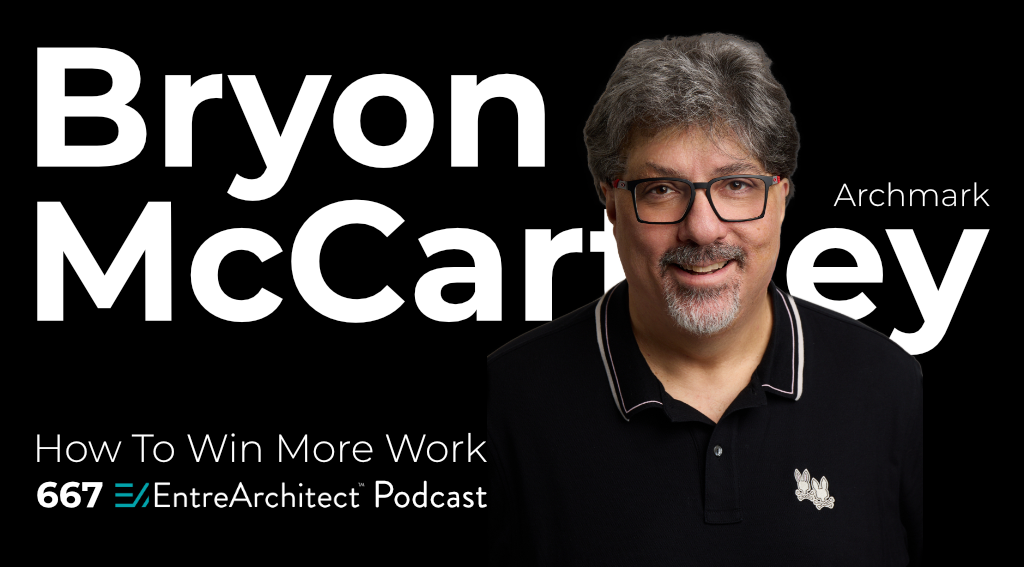
In my conversation with Bryon McCartney, CEO of Archmark and lead instructor at the EntreArchitect Academy, our business school for the small firm entrepreneur architect, we dug into the outcomes of the Academy’s first cohort. What he found there confirmed something I’ve watched play out across our community for years. The firms struggling to win work didn’t have empty pipelines. They had prospects who never got a real reason to say yes.
Why You Probably Don’t Have a Lead Problem
When we poll architects on where their business is weakest, project inquiries top the list almost every time. Bryon reminded me of a strategic planning workshop we ran at an annual meeting years ago, a room of roughly two hundred architects. When he asked which of the five drivers of a firm was their weakest link, nearly the whole room raised a hand on project inquiries. That’s not a coincidence. It’s a shared conviction, and it’s holding a lot of firms back.
Here’s the reframe. A quiet phone feels like a demand problem, so we try to solve it with more supply. More ads, more leads, more calls. But when you look closely at firms doing this, the prospects were usually already there. They had good conversations. They sent proposals. Then those prospects went with another firm, or stalled out entirely, because nothing the firm communicated gave them a reason to choose it.
So the better question isn’t how do I get more leads. It’s how many leads am I already losing? For most small firm architects, that gap between interest and commitment is where the money goes. Not to a lack of demand, but to a failure of positioning at the exact moment a client is deciding.
Stop Being the Hero of Your Own Website
The fix is a shift in who the story is about. Bryon is a StoryBrand certified guide, and as far as either of us knows, the only one working exclusively with architects. The framework behind StoryBrand, Donald Miller’s messaging model, comes down to one sentence that changes everything once you sit with it.
Your client is the hero of the story. You are the guide.
Think about how any story works. The hero has a problem. They’re anxious about it, and they are not looking for a second hero to show up and compete for the spotlight. They want a guide. Luke had Obi-Wan. Frodo had Gandalf. Someone who has been through something similar, understands what’s at stake, and can hand them a clear plan forward.
Now look at how most architecture firms present themselves. Our design philosophy. Our award-winning portfolio. Our years of experience. Bryon has reviewed about ten thousand firm websites, and the pattern is relentless. It’s all hero speak, and it’s usually the first touchpoint a client has with the firm. When you’ve cast yourself as the main character, you can’t then wonder why the client doesn’t feel connected to working with you.
I understand why we do this. It’s how we were trained. Good work gets great work. Present your credentials, show your portfolio, and you’ll be selected. That’s how juries work. That’s how RFPs work. That’s how design awards work. But a homeowner or a commercial client sitting across from three firms is not a jury. They’re a nervous person who doesn’t want to waste time, money, and energy on a problem they’ve never solved before.
Here’s the part that should stop you. That prospect cannot evaluate your detailing, your code knowledge, or your design philosophy. They aren’t architects. What they can evaluate is whether you understand their problem and whether you have a clear plan for them. Which is why clients so often don’t hire the best architect in the room. They hire the one who offers the clearest path forward.
One Email That Saved a Firm
Positioning sounds abstract until you watch it land. The clearest example from the cohort was Steve, a commercial architect running a solo firm in Wisconsin. On our first cohort call in January, Bryon asked everyone where their firm stood. Steve, a no-nonsense guy, said it flat out, “The phone’s not really ringing.” It landed like a mic drop, because anyone who has run a firm for more than a few years has said some version of that sentence out loud.
A few weeks later, Steve had a commercial prospect who told him he was one of three firms under consideration. The old Steve would have sent what Bryon calls the waiting room email: “Here’s our proposal, let me know if you have any questions.” Polite, available, and completely forgettable. Instead, Steve used the framework he learned in the Academy.
He named the owner’s problem in plain language. He named what was at stake if the project stalled, something he’d never done before and most architects never do. He laid out a simple plan and one line on why he was the guide to walk it through. Then, instead of “let me know,” he closed with the proposal attached and a direct question: “When should we schedule our discovery session?”
He sent it Thursday. Saturday morning he woke to a reply the client had sent Friday night. The client had already cut one of the three firms, and then told Steve the date of his bank meeting. People do not hand you their financing timeline when they’re about to reject you. That’s not a maybe. That’s a schedule.
By the final session in April, Steve had signed roughly six contracts tied to what he learned in those first weeks. No new website. No ads. Not a single new lead. Same phone, same market, same firm. One reframe and a different way of writing an email. In January it was “the phone’s not ringing”. By April it was “I don’t know how I’m going to get all this work done.” Most firm owners I know would take that trade every time.
The Six Places Firms Quietly Get Stuck
Steve’s email is where the thinking showed up, but the thinking runs deeper. The EntreArchitect Academy is a sixteen week live cohort built around the six areas where small firms tend to struggle in silence: leadership, or clarity on where you’re taking the firm; marketing, learning to position yourself as the guide; sales, where that email structure lives; services, pricing in tiers rather than defaulting to one number; operations and overhead, guiding the people who help you; and cash flow.
Most owners are good at one or two of these. The rest, as one participant put it, they’ve just been winging. That’s the real issue. Nobody hands architects a system for the business of architecture. We were handed a system for the work and left to improvise the rest. Doing good work is the price of entry, not the strategy. The firms that win consistently have decided to be intentional about the business, not just the design.
I’ll be honest about the hard part, because it matters. None of this works unless you do the work. The owners who leaned in, who treated it as an investment in themselves rather than one more thing in the inbox, got results. The ones who let it sit got less. There’s no magic button, and anyone promising one isn’t being straight with you. What there is, is a clear path and people walking it with you.
Where to Start
If your phone has gone quiet, resist the reflex to spend your way out of it. Before you rebuild the website or fund another round of ads, look hard at what your firm is actually saying to a prospect in the moment they’re deciding. Are you the hero of every sentence, or are you the guide who understands their problem and hands them a plan? That single shift, from talking about yourself to walking with your client, is how architects win more work without spending a dollar on marketing.
This is the kind of clarity we build toward firm by firm. A stronger, more sustainable practice deserves the same intention you bring to the design.
To hear my full conversation with Bryon, including how he’s bringing AI into the next cohort this fall, listen to the episode at https://entrearchitect.com/667.
And if you want to walk through this yourself, start with the free mini-course. It takes the same hero-to-guide foundation that got Steve’s phone ringing and breaks it into short lessons on the six places firms get stuck. Sign up at https://entrearchitect.com/firmfix, then do the work. That first step will tell you more about your firm than another month of waiting for the phone to ring.

Leave a Reply