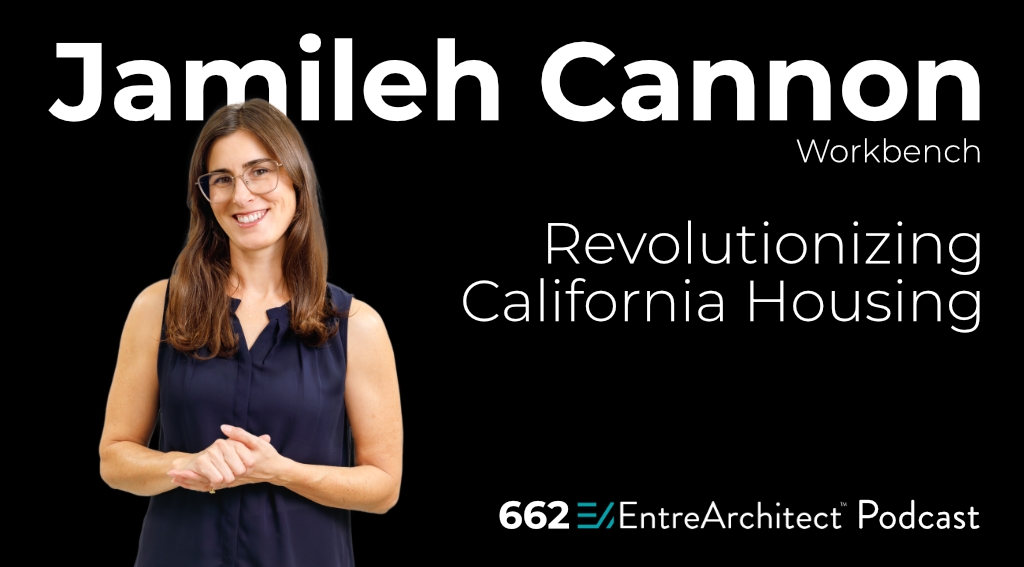
Jamileh Cannon of Workbench shows what happens when architects stop waiting for clients and start leading projects themselves.
Most architects wait to be hired.
We wait for the client to come with the site, the program, the budget, and the permission to begin. We do excellent work within the boundaries we’re given. And then we hand it off, step back, and wait for the next one.
That’s the traditional model. It works. But it’s not the only way to practice, and for a growing number of small firm architect entrepreneurs, it’s not the most fulfilling or the most financially durable way to build a business.
My conversation with Jamileh Cannon, co-founder of Workbench in Santa Cruz, California, opened a window into a different kind of practice entirely. Workbench is a vertically integrated housing developer. Architecture, construction, and development all live under one roof. Jamileh and her partners don’t just design housing; they identify sites, secure funding, lead entitlements, manage construction, and deliver finished projects into communities that desperately need them. As an architect as developer, Jamileh controls the whole process from vision to completion, and that changes everything about the work.
Why Architects Are Uniquely Positioned to Develop
There’s a persistent idea in our profession that development is someone else’s territory. Developers hire architects. That’s the order of things.
But Jamileh’s story challenges that assumption at its foundation. She came out of architecture school, worked briefly in traditional practice, moved into construction management, spent six years as a project manager for a large multifamily general contractor, and then built something new. The path wasn’t linear, but every piece of it was preparation.
What she found on the other side of that transition was that her architectural training was not a liability in the development world. It was a structural advantage. She and her team can run a base density study or produce a quick site diagram in-house, on short notice, without involving another firm. Her design team has built so many of the same housing typologies that they get projects right the first time. The feedback loop between design decisions and construction costs is direct and immediate, because the same organization is bearing both.
That integration creates a kind of clarity that traditional practice rarely produces. You’re not interpreting someone else’s vision. You’re building your own.
The Architect as Developer Model in Practice
Workbench didn’t start at scale. It started with one infill parcel in Santa Cruz, a scrappy funding search, extensions stretched to the last possible day, and a financial partner secured a week before the deadline. Jamileh describes that first project with the kind of specific, earned detail that only comes from having lived it: closing on the bank loan the day before they had to buy or lose the property, ending up with 15 units instead of five or six by waiting out the density bonus window, keeping both existing homes on the lot because post-COVID construction costs made tear-down pencil differently.
That first project was also parallel to a growing ADU practice, and eventually to a nine-home project for developmentally disabled adults with a unique funding structure. Three different work streams at once, each with its own client, its own complexity, its own financial logic.
That kind of plate-spinning is familiar to anyone running a small firm. What’s different here is that all of it was building toward something owned, not just delivered. The work wasn’t just billable hours. It was equity. It was community. It was a portfolio of places that exist in the world because Workbench chose to build them.
Today, Workbench has roughly 150 units built, another 200 nearly complete, and about 1,700 in the pipeline. They run pre-approved ADU programs for jurisdictions throughout California and develop larger multifamily projects ranging from 50 to 350 units. They are, in Jamileh’s words, essentially running three companies simultaneously: a construction company, a design company, and a development company. She’s the first to say she hasn’t figured out how to make that easy. But she’s also clear that it’s the right model for what they’re trying to do.
What Infill Housing Teaches About Firm Strategy
One of the things I find most interesting about Jamileh’s work is how she thinks about niche. Infill is not just a project type for Workbench. It’s the organizing principle of the whole practice. Santa Cruz is land-constrained, hemmed in by ocean, mountains, and protected agricultural land. The solution to the housing shortage there is not greenfield development. It’s creative density on parcels that already exist.
That constraint became a brand. “Infill is our niche and our story”, she explained. “We take the difficult, the overlooked, the underbuilt parcel and find what it can actually become.”
That’s a lesson that applies far beyond California housing. The firms I’ve seen build the most durable practices are the ones who choose their lane and commit to it. Not because they can’t do other things, but because clarity about what you do and who you serve makes everything downstream easier: marketing, hiring, pricing, culture, and the quality of the work itself.
Jamileh found her lane by following what she actually cared about, density, community, the kind of walkable urban fabric she first encountered as a kid visiting San Francisco and later studying in Florence. She built a business around that instinct. The niche didn’t limit her. It focused her.
The Real Advantage of Vertical Integration
When I asked Jamileh what makes Workbench different from other developers, her answer was immediate: nimbleness. Not in the startup sense of moving fast and breaking things, but in the operational sense of being able to make good decisions quickly because all the information lives in the same organization.
When a developer is trying to understand what something will cost to build, they typically have to ask someone else. When a design team is trying to understand whether a decision will hold up in construction, they find out months later and expensively. At Workbench, the architecture team and the construction team are having that conversation across the same office. The lessons learned from the last project get applied to the next one, not lost in the handoff between firms.
That integration also shows up in their jurisdiction-level ADU work. When a city or county contracts with Workbench to produce pre-approved ADU plans, the design team isn’t just drawing buildings. They’re building a system that removes barriers for homeowners who would otherwise face months of plan check and significant professional fees just to get started. Workbench retains joint ownership of those drawings, which means the investment pays forward across multiple jurisdictions, not just one.
That’s what intentional business design looks like. Every engagement builds something that compounds.
Firm Culture as a Competitive Advantage
One thing Jamileh said that stayed with me had nothing to do with housing policy or development finance. It was about how Workbench handles time.
They have a flexible, largely merit-based culture. Two anchor days in the office, Tuesdays and Thursdays, and everyone has latitude over the rest. If you need to leave at one o’clock to pick up your kids, you leave. You come back and finish the work. Leadership doesn’t track it, and nobody abuses it.
This matters strategically, not just humanly. The firms that attract and retain the best people in 2025 are the firms that are honest about what professional life looks like when you’re also a parent, a caregiver, or just a person with a life outside the office. Flexible culture isn’t a perk. It’s a signal. It tells your team that you trust them, and it creates an environment where people want to stay and do their best work.
Jamileh built that culture not from a policy manual but from lived experience, raising young kids during COVID, realizing that the old model of a 40-plus-hour rigid workweek was incompatible with anything resembling a full life. She built something better. Her team reflects that.
The Regulatory Landscape Is Shifting
If you’re an architect doing multifamily or infill housing work in California, or thinking about it, Jamileh’s practical advice is worth holding onto: stop relying on local zoning as your ceiling.
State law in California has changed dramatically over the last decade. Density bonuses, ADU reform, and a growing body of housing legislation have fundamentally altered what’s possible on infill parcels. The local zoning still exists, but in many cases it’s no longer the binding constraint. A site that appears to support five or six units under local code may support 15 under state law.
That gap is where opportunity lives for architect entrepreneurs who do the work to understand it. The clients showing up with potential multifamily sites often don’t know what those sites can actually become. The architect who can walk in with that knowledge and that vision is not just a service provider. She’s a strategic partner.
What the Architect as Developer Path Really Requires
I don’t want to romanticize this. Jamileh will be the first to tell you that running three integrated companies is genuinely hard. Capital is always a constraint. Decision fatigue is real when every call across design, construction, and development lands on the same small leadership team. The funding cycles for development work are long and lumpy, with money arriving at major milestones rather than steadily through monthly invoices.
But the upside is real too. Control over what gets built. Equity in the outcome. Work that is directly tied to community impact and place. A business model where the architect is not the last one hired and the first one cut, but the one driving the whole enterprise.
That’s worth thinking hard about, whatever your context, whatever your market.
The architect as developer model is not for everyone. But it might be for more of us than we’ve allowed ourselves to imagine.
Listen to my full conversation with Jamileh on the EntreArchitect Podcast, Episode 662.
And if you’re ready to build a better firm alongside other small firm architect entrepreneurs who are asking the same hard questions, join us at the EntreArchitect Network.

Leave a Reply