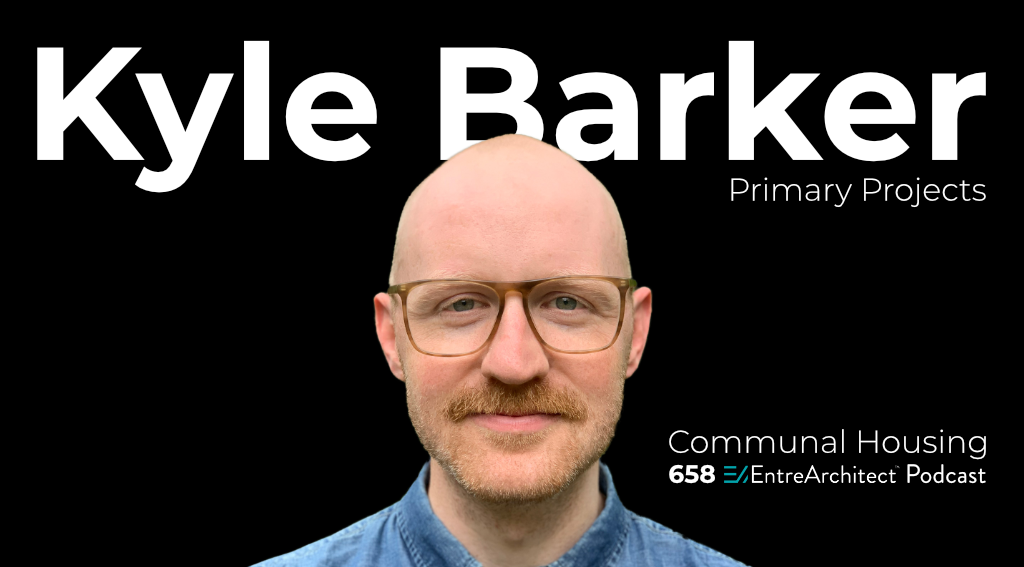
How narrowing your focus, knowing your niche, and building a body of work can define your practice and your legacy.
Most architects I talk to are afraid to specialize. They worry that narrowing their focus means turning away work, shrinking their opportunity, building a smaller firm. So they stay broad. They say yes to everything. They describe themselves as designers who can handle any project type, any client, any challenge.
I understand that instinct. I lived it. But housing design for small firm architects is one of the clearest examples I have seen of what happens when you do the opposite, when you choose your focus deliberately and then go deep. My conversation with Kyle Barker, founder of Primary Projects, reminded me exactly why clarity is not a constraint. It is your competitive edge.
The Trap of Staying General
Here is what staying general actually costs you. It costs you a message. It costs you a body of expertise. It costs you the kind of reputation that makes clients seek you out specifically, rather than compare you to every other firm in the region.
Kyle spent nearly a decade working for other firms in Boston before starting Primary Projects in 2021. During that time, he was developing his thinking, not just his technical skills. He was getting interested in specific things: deeply sustainable construction, housing that creates community, affordability across the full spectrum of design, not just capital-A affordable housing. The longer he worked for others, the more his particular passions came into focus.
When he finally launched his own practice, he led with housing. That felt like enough of a niche at first. But over the next several years, he kept narrowing. He realized he was never going to compete with large firms building two- and three-hundred-unit double-loaded corridor buildings, the kind of repetitive floor-plate work that almost designs itself. That was not the best use of his skills, and he knew it. So he pushed further: smaller-scale infill, community-centered multifamily, projects where design thinking genuinely changes how people live.
Every six months, he told me, he felt a greater sense of clarity about the kind of work he was best suited to do.
That is not accidental. That is intentional.
What Specialization Actually Looks Like
We talk a lot in this community about picking a target market. And people often hear that as a marketing exercise, a positioning statement, a line on a website. Kyle’s story is a reminder that real specialization goes much deeper than that.
It is a research commitment. Kyle has spent years studying housing models around the world, not as a hobby but as a core part of how he practices. That research eventually led him to win the Roach Traveling Scholarship, which funded two six-week international trips to study communal housing in Europe, Australia, and Japan. He visited roughly 55 communities. He took more than 12,000 photos. He talked to the architects who designed those places and the people who live in them.
That is what deep expertise looks like. Not a tagline. A body of work built through sustained curiosity and intentional study.
It is also worth noting what Kyle said about the practical business side of staying somewhat diversified even while being focused. He takes on other project types occasionally, including commercial and institutional interiors work that moves at a completely different pace than housing. When housing slows, those faster-moving projects can carry the firm. When asked about the risks of specialization, he offered a more nuanced picture: lead with your expertise, build your reputation around it, and allow some flexibility in practice without letting that flexibility blur your message.
That balance matters. Clarity in your positioning does not require rigidity in your project list. It requires consistency in what you stand for.
Building a Body of Work That Outlasts Any Single Project
One of the things that struck me most in my conversation with Kyle was this: he is building something that goes beyond individual commissions. The Communal Housing Design Guidelines, the book that emerged from his scholarship research, is exactly that kind of artifact.
The book is structured as 40 lessons organized across seven categories: circulation, economy, storage, flexibility, privacy, expression, and inclusion. It is designed to be used as a reference, not read once and shelved. Kyle was explicit about his intention: he wanted to create something that other architects and housing designers could return to, as practitioners have for decades to Christopher Alexander’s A Pattern Language.
That ambition matters for how you think about your own practice. What are you building that is bigger than the next project? What knowledge are you accumulating that could serve this profession, not just your current clients?
For most small firm architects, the answer is: not much. Because we are heads-down in the work. We are managing projects, handling clients, keeping the business alive. The strategic, generative work, the kind that builds a lasting reputation and a meaningful body of expertise, tends to get crowded out.
Kyle’s path is a useful model. He did not write the book in a vacuum. The research came first, funded by a competition he entered five times before winning. The book came out of a requirement he chose to transform into something more enduring. One thing led to the next. His practice, his teaching at Northeastern, his research, and now his published work all reinforce each other.
That is stewardship of your expertise. Not just doing good work for individual clients, but building something that grows in value over time and serves the profession.
Clarity on Positioning Is Not Enough on Its Own
Kyle offered three practical recommendations at the end of our conversation that I want to pass along, because they ground all of this in the daily reality of running a small firm.
First: track your hours. He is direct about this. You cannot price your work if you do not know how long things actually take. Whether you bill hourly or not is beside the point. The data matters. His own approach is simple: a small notebook beside his desk where he jots time as he works, then enters everything into a spreadsheet at the end of the week in a single sitting. That keeps the administrative burden low while keeping the data accurate.
Second: read Getting to Yes. As a small firm owner, you are now the person negotiating fees, scope, and client relationships, not just the person doing the design work. Learning to negotiate well is not optional. Kyle found this book valuable enough to read twice.
Third: read How to Win Friends and Influence People. He was skeptical of it at first, the way many architects are of anything that sounds like sales. But for those of us who came up on the technical and design side of practice, without much exposure to business development, it is a genuinely useful resource. The ability to build relationships, not just execute projects, is part of what running a small firm requires.
Practical tools in service of a clear vision. That combination is what builds a firm that lasts.
The Work You Were Meant to Do
There is something Kyle said early in our conversation that I keep thinking about. He described himself as someone who is not naturally a risk-taker. Starting a practice was not an easy call for him. He prepared carefully, made sure he had some income in place, built the business knowledge he felt he was missing, and then made the move with as much clarity as he could bring to it.
What pushed him was not confidence in the abstract. It was confidence in his specific direction. He knew what he cared about. He knew what kind of work he was best suited to do. He had built enough expertise, through years of working for others and years of his own research, that he trusted his point of view.
That is the thing about clarity. It does not eliminate fear. It gives you something solid to move toward even when the fear is present.
If you are running a small firm right now and you feel like you are doing a little of everything without a strong sense of where you are truly building something, this conversation is worth your time. Not because Kyle has a system to sell. He does not. But because his path is a real and honest example of what it looks like to build a practice around something that genuinely matters to you, and to do it with intention.
That is the work. And it is available to every one of us.
Listen to my full conversation with Kyle Barker on Episode 658 of the EntreArchitect Podcast at https://entrearchitect.com/658.
And if you are ready to build a better firm alongside other small firm entrepreneur architects who are doing the same work, join us at the EntreArchitect Network at https://entrearchitect.com.

I strongly believe that “research is the soul of design.” Seeing how Kyle transformed his scholarship into a “Design Guideline” is exactly how we should bridge the gap between academia and the professional world in GTU. Expertise isn’t a title; it’s a body of work. Thank you!