The older I get, the more I recognize that the most important parts of my life rarely announced themselves when they arrived. A conversation, a struggle, a person who believed in me, an unexpected opportunity, even a failure I would have preferred to avoid. In the moment, these experiences can feel disconnected. Only years later do we sometimes recognize that they were preparing us for something.
I have come to believe the same is true of our careers as architects. We spend so much time trying to determine where we are going that we rarely stop to consider what everything behind us may have been preparing us to do.
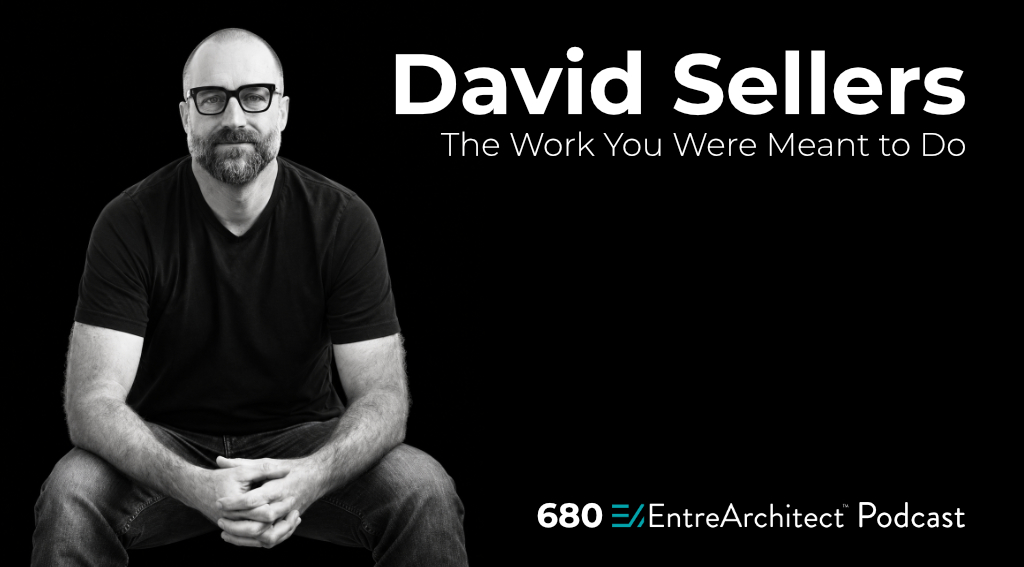
David Sellers has one of the most unusual career journeys I have encountered in nearly 700 episodes of the EntreArchitect Podcast. His path includes experiences that, at the time, must have seemed completely unrelated. Looking back today, we can see how each experience developed a skill, opened a door, introduced a relationship, or prepared him for an opportunity that would come years later.
Early in our conversation, David said, “Everything in my life has been connected because of work.”
By the end of our conversation, I understood exactly what he meant.
Sometimes We Understand the Preparation Only Later
David grew up in East Texas surrounded by oil fields and strip mines. At the same time, he loved camping, hunting, fishing, and being in the wilderness. He remembers watching landscapes he loved being dramatically altered and wondering why there wasn’t a better way.
That tension between energy, the built environment, and the natural world would eventually become central to his work. But a kid growing up in East Texas could not possibly have known where those observations would lead.
There was another part of his childhood that struck me. David was dysgraphic. In elementary school, he spent several years in special education because writing and organizing letters on a page was difficult for him. He eventually came to understand that his brain naturally thinks in three dimensions. The thing that once caused embarrassment as a child looks very different when viewed through the lens of the architect he eventually became.
I think many of us can look backward and identify experiences like these.
Maybe it was growing up in a family business. Maybe it was working construction during the summer, struggling through school, caring for someone we loved, losing a job, traveling somewhere unfamiliar, or spending years doing work that seemed unrelated to where we eventually ended up.
We tend to edit these experiences out of our professional stories because they don’t fit neatly on the résumé.
Maybe those are exactly the experiences we should be paying more attention to.
Sometimes One Person Changes the Direction of a Life
When David was in ninth grade, his class was studying the history of their high school. His teacher invited one of the architects who had designed the building to speak with the students.
David had never met an architect.
He assumed architects probably came from somewhere like New York. Instead, this architect was from David’s own town. He had gone away to study architecture and returned home to practice.
That encounter didn’t immediately convince David to become an architect. It did something more subtle and perhaps more important. It allowed him to imagine himself as one.
Years later, that architect remains a mentor and confidant. When David and I spoke, he showed me original pencil-on-vellum drawings from that architect that were stored in a tube directly behind his desk.
That story shows us just how little it can sometimes take to change the trajectory of another person’s life.
We often underestimate the influence we have as architects, employers, mentors, teachers, parents, and leaders. Sometimes showing someone what is possible is enough. We may never know which conversation, invitation, internship, studio visit, or word of encouragement becomes the moment someone remembers decades later.
David knows that because it happened to him. Today, he mentors high school students, supports scholarships, brings interns into his firm, and looks for opportunities to become for someone else what that architect was for him.
That is when a meaningful architecture career begins to become about something larger than ourselves.
The Fishing Boat Was Part of Architecture School Too
David didn’t come from money. He attended college with the help of Pell Grants and worked in an auto shop to pay the bills. Then someone told him that his mechanical skills could earn him good money working on commercial fishing boats in Alaska.
So he went.
Eventually, he became a boat captain. He learned logistics, mechanical systems, power generation, batteries, water, navigation, decision-making, and how to operate in remote environments where problems needed to be solved with whatever resources were available.
On a conventional architecture résumé, commercial fishing in Alaska might appear to be the thing David did so he could afford architecture school.
It wasn’t.
In its own way, it was part of his architecture education.
Years later, after graduate school at TU Delft in the Netherlands, David received a job posting from someone who told him he was the only person they knew who seemed to fit it. The Nature Conservancy was looking for someone to work at its research station on Palmyra Atoll, a remote U.S. territory in the Pacific about 1,000 miles south of Hawaii. The position required an unusual combination of experience in remote locations, marine environments, boats, construction management, diving, aviation, and logistics.
Suddenly, experiences that had once seemed unrelated were qualifications.
Sometimes we only understand the preparation after we discover the purpose.
The difficult project may be teaching you something. The job you didn’t particularly want may be developing a skill you will eventually need. An interest that seems unrelated to architecture may someday distinguish your practice from every other firm competing for the same work.
Nothing needs to be wasted if we are willing to learn from it.
The Blueprint David Never Forgot
One of my favorite moments in our conversation had almost nothing to do with David’s professional career.
When he was about eight years old, a gate latch broke. David was very close to his grandfather, who taught him how to build things. Rather than simply repairing the latch, his grandfather sat down with him. They measured it. They drew it in pencil. Then they went and had a blueprint made.
David told me he can still remember walking into the shop and smelling the ammonia.
It was his first blueprint.
His grandfather didn’t need a blueprint to fix a gate latch. He took the time anyway.
I love that story because meaningful careers are built from moments like these. We remember the people who slowed down enough to teach us. We remember the first time someone trusted us with something important. We remember the smell of the shop, the feel of the tools, the drawing pinned to the wall, or the person who showed us how something worked.
Those experiences become part of how we see the world.
Eventually, if we are paying attention, they become part of what we give back.
Finding the Work Is Not Enough
While studying architecture, David once had the opportunity to ask architect Steven Holl one question. David asked what Holl would spend more time learning if he could return to architecture school.
His answer was, “Focus on business.”
David took that answer seriously. He started studying business and paying attention whenever he encountered something that could teach him more. He began thinking about architecture not only as design, but as an enterprise that needed to work.
That decision became critical to everything that followed.
David’s firm today does significant pro bono and reduced-fee work. They contribute to community projects. They work on housing. They support Habitat for Humanity. They invest in renewable energy and experiment with technologies and materials they believe can change the future.
None of that happens because business is unimportant.
It happens because business is critical.
David described combining passion with business acumen as creating a “war chest” that gives you the ability to pursue ideas rather than waiting for someone else to fund them.
That is a message I have been sharing with architects for years.
Profit is not the enemy of purpose.
Profit creates opportunity.
The process for pursuing meaningful work is, profit, then art.
Build the Business That Gives You Freedom
A financially fragile architecture firm has very little freedom. When every dollar is already committed and every project must keep the lights on, it becomes difficult to say yes to the project that matters but cannot pay your full fee. It becomes difficult to experiment, invest, mentor, donate your time, or take a risk on an idea you believe could make things better.
David didn’t build his firm by ignoring those realities. His team diversified deliberately. They brought structural and civil engineering in-house. They developed renewable energy expertise. They became a design-build firm. When David realized his firm was carrying substantial risk on renewable energy systems while contractors captured much of the financial reward, he changed the model.
Those are business decisions, and those decisions created capacity.
David can now look at a project and ask something beyond, “Will this project make money?”
He can also ask, “Does this matter?”
I see young architects struggle with this all the time. They want to pursue socially important work, start a nonprofit, provide services for people who cannot afford them, or devote significant time to pro bono projects. When we talk about business, they sometimes respond that money isn’t important to them.
I understand that instinct. Money isn’t the mission.
But a mission without a sustainable economic engine will always be dependent on someone else’s resources.
Build the engine.
Build the profitable, resilient business that gives you choices. Build systems that create freedom. Develop expertise people value enough to pay for. Protect your margins. Build reserves. Then use that strength deliberately.
Profit does not need to be the purpose of your architecture firm. Profit can be what gives your purpose the resources it needs to become real. Profit is your fuel.
Success Gives Us the Ability to Serve
One of the most powerful examples David shared involved Habitat for Humanity. His firm is working on a mass timber project and has the financial capacity to donate renewable energy equipment and installation. David explained that they could not do something like that if the business were not financially successful.
That is the connection I wish more architects understood.
Building a successful firm and building a meaningful architecture career are not competing goals.
They can strengthen one another.
A healthy firm can employ people well. It can mentor the next generation. It can invest in innovation. It can take on a reduced-fee community project without jeopardizing payroll. It can spend time exploring an idea before anyone agrees to fund it. It can respond when a community needs help.
David has experienced that directly through his work in Hawaii. The business he built gives him the capacity to put his values into action.
That, to me, is a much more compelling definition of success than simply making more money.
The question isn’t only how much profit your firm generates.
The deeper question is: What does that profit allow you to do?
What Has Your Life Been Preparing You to Do?
Near the end of our conversation, David talked about the work his firm is doing today: net-zero buildings, renewable energy, affordable housing, mass timber, schools, and projects pushing architecture in Hawaii in new directions.
Then he said something that brought the whole story together.
He sometimes has to pinch himself.
The things he hoped architecture could become are actually happening. His firm is doing them.
When I heard that, I thought about the boy in East Texas watching the landscape around him change. The child struggling to communicate in two dimensions. The ninth grader meeting his first architect. The eight-year-old making a blueprint with his grandfather. The college student sweating in an auto shop. The fisherman in Alaska learning how independent systems keep a vessel alive. The graduate student who followed a mentor’s suggestion to the Netherlands. The young architect who accepted a strange opportunity on a remote Pacific atoll.
None of those experiences were wasted.
Maybe you already know what your work is meant to be. Maybe you’re still trying to figure it out. Either way, don’t discount what came before.
Look back at the people who influenced you, the work that challenged you, the things that came naturally, the things that were painfully difficult, the opportunities you accepted without knowing where they would lead, and even the detours you once wished you could erase. Somewhere in those experiences may be clues to the contribution that only you can make.
Then look at your business.
Is it becoming strong enough to give you the freedom to make that contribution?
Because a meaningful architecture career isn’t only about finding work you love. It is about becoming the person capable of doing work that matters and building a business strong enough to make that work possible.
David’s story reminded me that we may not recognize the preparation while we are living it. Sometimes it takes years before we can look backward and understand why certain people, experiences, struggles, and opportunities became part of our story.
And maybe that is when we finally begin to recognize the work we were meant to do.
Listen to my complete conversation with David Sellers on EntreArchitect Podcast Episode 680.

Leave a Reply