The Gap Between Our Expertise and What Clients Actually Want
You walked into the room prepared. You knew your work. You had the images, the awards, the story of the firm, the reasons you were the right choice. You presented well. And you still lost the project to someone you were sure you could out-design.
If you have run a firm for any length of time, you have lived this. It is one of the most demoralizing parts of the business, because it feels like the work should speak for itself. It doesn’t. Learning how to win architecture clients has very little to do with proving you are the best architect in the room. It has almost everything to do with understanding what the person across the table actually came to hear. Most architects get that wrong, and they get it wrong in a way that stays invisible until enough lost projects force the question.
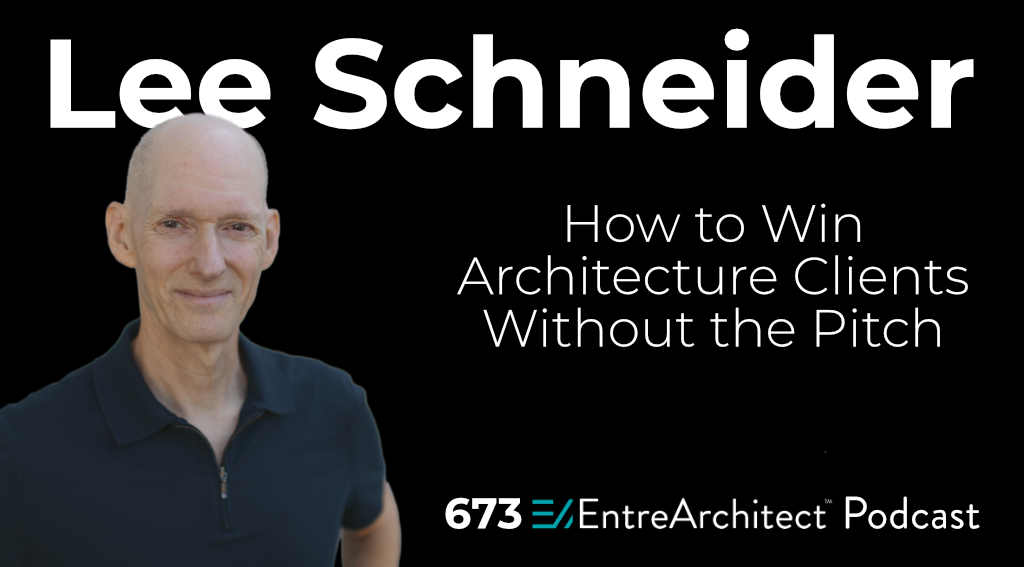
I have watched this dynamic play out for more than thirty years, from my own firm to the thousands of small firm architects I have worked with since. So when Lee Schneider, who teaches architects at the USC School of Architecture how to communicate their ideas, brought up a particular survey in our conversation, it did not surprise me so much as put hard numbers to something I have seen the whole time. The AIA, along with a British counterpart, asked architects why they do the work. The answers were exactly what you would expect. We care about sustainability. We want to make things that are beautiful. We want the building to work. We want to serve our clients well. It is an honest, admirable list, and every architect reading this shares most of it.
Then they asked prospective clients what they wanted from an architect. The list was different. Not opposite, but different in a way that changes everything about how you walk into the room.
The Gap You Cannot See From Your Side of the Table
Clients want the building to work. They want it to be cost effective. None of that surprised anyone. But the thing they wanted most was something architects rarely lead with. They wanted to be heard. They wanted to be listened to. They were looking for collaboration, for a sense that the project was something built with them rather than delivered to them.
Sit with that for a moment, because it exposes a gap most firms never account for. You prepare to walk into a room and demonstrate expertise. The client walks into the same room hoping to be understood. You are rehearsing answers. They are hoping you will ask the right questions. You are ready to tell them who you are. They are waiting to find out whether you can hear who they are.
This is the quiet reason so many strong firms lose to firms with lesser portfolios. It is not a talent gap. It is a listening gap. The architect who wins is often not the one who presented the most impressive body of work. It is the one who made the client feel like a partner in something rather than an audience for someone else’s brilliance.
Why “I Am the Genius” Is a Losing Story
There is a version of the sales conversation that a lot of firms default to without realizing it. It says, in one form or another, I am the expert here, I have done this many times, trust me and let me handle it. Lee described the internal version of this bluntly. Some architects look inside themselves and conclude they are simply the smartest person in the room, the established authority, and the client should feel fortunate to work with them.
If you are a household name with a signature style people travel to hire, maybe that works. For the rest of us, and that means nearly all small firm entrepreneur architects, it fails. It fails because it puts you and the client on opposite sides of a table. You become the holder of wisdom and they become the grateful recipient. That is not a relationship. That is a transaction with a hierarchy baked into it, and clients feel the hierarchy even when you think you are hiding it.
What clients told that survey is that they do not want to be dictated to. They do not want to be handed a finished vision and asked to admire it. They want to know they have a say. They want the project to be a shared undertaking. The firm that understands this walks into the room with a fundamentally different posture, and that posture is what earns trust before a single drawing is discussed.
Receiving Their Story Matters as Much as Telling Yours
Here is what matters most, and it took me years in practice to fully understand it. Winning the work is not about the story you tell. It is about the story you receive.
Every client walks in carrying a story. They have a problem, a gap, a hope, a fear about spending a great deal of money on something they cannot fully picture yet. They have been burned before, or they have heard that architects are difficult, or they simply do not understand what you do and are nervous about admitting it. If you spend the entire meeting focused on your own presentation, you never hear any of that. And if you never hear it, you cannot possibly address it.
Many of us rehearse the presentation in the mirror until it is polished, then walk in and deliver it flawlessly, right up until the client asks a question we were not expecting. In that moment the polished delivery becomes a liability, because we were so focused on our own next line that we failed to actually listen to what was being asked. The preparation that matters is not memorizing what you plan to say. It is preparing to be present enough to receive what they say.
This is a discipline, and it is learnable. Before the meeting, do the research. Understand who these people are, what they have built or bought before, what they say about themselves publicly. In the meeting, watch them. Are they leaning in or looking around the room? Are they still with you, or did you lose them three slides ago? Reading the room is not a soft skill you either have or you don’t. It is attention, deliberately applied, and it tells you when to keep going and when to stop and ask what they are really thinking.
What This Looks Like in Your Next Meeting
Translating this into practice does not require a new marketing system. It requires reordering how you show up. Three things shift when you take this seriously: you research before you speak, you ask before you tell, and you listen for the client’s real need instead of waiting for your turn to talk.
Start the meeting by understanding what they came for. A prospective client arrives with a need and a gap, and your first job is to understand both, not to fill the silence with your credentials. When you do speak to your own experience, frame it around collaboration rather than authority. The goal is not to prove you are a rare genius standing above them. It is to prove you are someone worth working with, a colleague who will build this thing alongside them and take the responsibility seriously.
That last part is not a soft sentiment. It is becoming your most valuable asset. As artificial intelligence absorbs more of the technical and production side of what we do, the human-to-human connection becomes the premium offering. A machine can generate options. It cannot sit in a room, feel the weight of a client’s uncertainty, and earn their trust in real time. It cannot be responsible or liable for the outcome. Only a person can do that, and clients know it. The firm that can win a room full of humans, by listening as well as it speaks, is the firm that will keep winning work when so much else has been automated away.
The Firm That Listens Wins
None of this asks you to be a lesser architect. Your expertise still matters. Your portfolio still matters. But they are the price of admission, not the reason you win. You win when the client leaves the room feeling heard, feeling like a partner, feeling like you understood their story before you asked them to buy into yours.
This is intentional work. It means walking into every meeting with your own clarity about why you do this, and equal clarity about the fact that the meeting is not actually about you. It is about them, and about whether the two stories can become one shared project. Get that right, and you stop competing on price and speed and credentials. You start competing on trust, which is the one thing no one can undercut.
To hear the full conversation with Lee, including his thinking on brand story, the mistakes architects make in presentations, and where AI does and does not belong in the work, listen to the episode at https://entrearchitect.com/673.
And if you are ready to build a better firm alongside other small firm entrepreneur architects who are doing the same, join us in the EntreArchitect Network at https://entrearchitect.com. The work is hard, but you do not have to do it alone.

Leave a Reply