Your client cannot tell the difference between a good set of drawings and a great one. They can tell the difference between a building that works and one that fights them for thirty years. That gap is where the value of an architect lives, and most small firms have spent a career selling the wrong side of it.
We told clients we were fast. We built firm identities around turnaround time, sheet counts, and how few RFIs came back. Production was easy to point at, so production became the pitch. And every time we made that pitch, we shrank the value of an architect down to something a client could put on an invoice line and shop around for a cheaper version of.
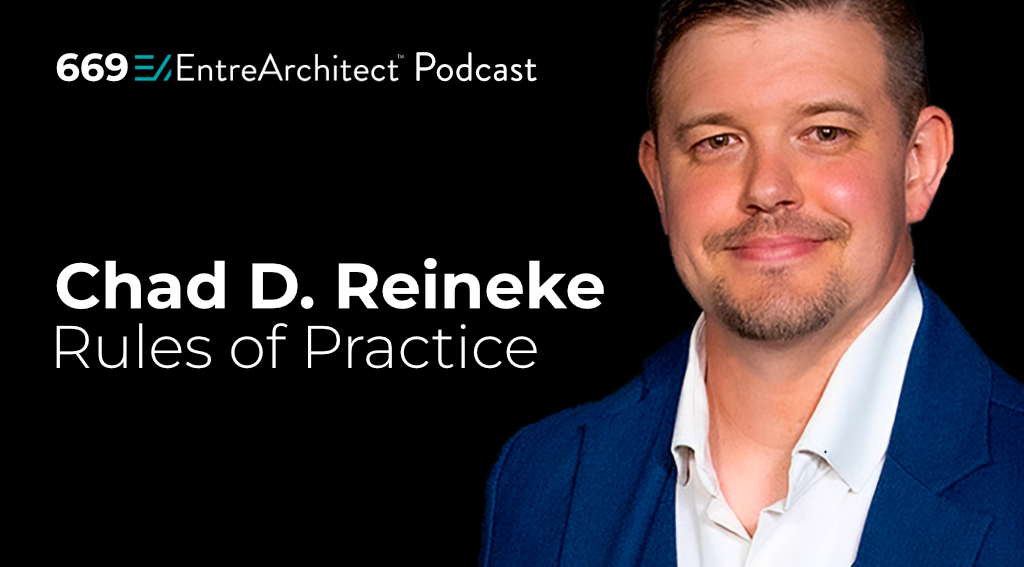
Chad D. Reineke is an architect, educator, and author whose new book, Rules of Practice: The Ethics of Making Architecture, digs into the ethics of how we actually make architecture. What stopped me in our conversation on the EntreArchitect Podcast was not a prediction about technology. It was how sharply Chad named something I have watched erode for years: the profession competing on production while its real value went unspoken. The value of an architect was never the production. It was always the judgment. We let ourselves forget that, and now we are being handed a rare chance to remember.
We Sold the Wrong Thing on Purpose
Speed felt like the product because speed was easy to prove.
CAD made us faster. Revit made us faster still. Each tool arrived promising that a competent architect could do more in less time, and each time we passed the savings straight to the market. We competed to produce quicker than the firm down the street. We measured ourselves in output. When production is the whole story, you have told the world that anyone who can produce can replace you. That is not a market position. That is a commodity waiting for a lower bidder.
The reason we did it is not mysterious. Deliverables are legible. A client understands a drawing set, can count the sheets, can put a number on it. Judgment is harder to point at and harder to defend in a fee conversation, so we reached for the thing that was easy to sell and let the thing that mattered slide. It is easier to sell deliverables than to sell judgment. Easier is not the same as right, and the firms that chose easy made themselves smaller for it.
Judgment Is the Thing They Are Actually Buying
Clients do not hire you to draw. They hire you to prevent the problems they cannot see coming.
A client will tell you exactly what they want, and the easiest move in the world is to give it to them. But what they describe is usually their guess at a solution, not their actual problem. The work is to push back when pushing back serves them, to design for the building they will occupy in ten years instead of the one they asked for this morning. Chad’s example from industrial work makes it concrete. On those projects, the first move was often a variance for reduced parking. Every client instinct says pave the whole lot, and every factory you have driven past sits behind a sea of asphalt two-thirds empty. The judgment call is to design the first year honestly, hold the extra land in reserve, cut the stormwater burden now, and leave room to expand only if it is ever truly needed. The client did not ask for that. The client could not have asked for that. That is the entire point.
Or take the move that looks like nothing: a slant on an overhead ledge so dust rolls off instead of collecting, so the cleaning crew is not fighting the building for its whole life. The client is not the cleaning crew. The client is not the maintenance team. Often the client is not even the person who will occupy the space. Someone has to hold all of those unspoken users at once, and that someone is the architect. That is not a nicety layered on top of the work. That is the work.
Chad calls this the ethics of practice, and he does not mean the courtroom kind. He means the ordinary decisions about scope, code interpretation, staffing, and what you are willing to let leave your office. Those quiet calls, made well or badly, are where the value of an architect actually sits. They are also, and this is the part that should change how you run your firm, exactly what a machine cannot do for you.
AI Does Not Threaten Your Value. It Exposes It.
The fear runs like this: AI produces faster, so the work disappears. Chad flips the logic, and the flip is a business decision more than a technical one.
Yes, the tools will absorb the rough drafting. Within a decade Chad expects you will sketch or model an intent, load it into software, and get drawings and construction documents out the other side. When that happens, the market will reflexively demand shorter schedules. Do not give them shorter schedules. Hold the schedule and spend the reclaimed time on a better project. That single choice decides which kind of firm you become. Compress the timeline and you are a faster commodity handing your savings to the client, exactly as we did with CAD and Revit. Redirect that time into judgment and the long life of the building, and your influence moves back toward the thing no competitor and no tool can supply.
The limits of the technology make the case stronger. Chad pointed to genuinely advanced AI design software built by people he respects, and even its creators will tell you that left alone it produces a code-compliant, program-adjacent, thoroughly ugly building. The machine calculates. It does not weigh nuance. It is only ever as good as its database and your reading of what comes out. A person still has to look at the result and ask whether it does what it needs to do, because a human occupies that building for fifty years, not another computer.
So the honest posture toward AI is not fear. It will not replace architects. It will shift how we work, it will force us to fight for our place in the conversation, and if we passively let our value drift, we will lose some of it. The firms that adopt these tools and lead the process will be fine. The ones waiting for permission will watch someone else lead it for them.
What to Do With This on Monday
This is not a keynote idea. It changes how you describe your firm this week.
Refuse the commodity frame in your own language first. Stop leading with speed and sheet counts. Lead with the prevented problem and the building that still works in fifteen years. Say the plain version out loud, in blunter words than feel comfortable: your client is not paying for production, they are paying for your judgment to make their life simpler. They are not the expert on the building. You are. Repeat it until clients start saying it back to you.
Then protect the conditions that make judgment possible. Adopt the tools, but do not let the efficiency spend itself on a shorter timeline by default. Decide, on purpose, that reclaimed hours go into better thinking and a better building. That is a positioning decision and a pricing decision at once, and a small firm can make it far faster than a large one can.
And if you lead people, sit with the question Chad and I circled without fully solving. When the entry-level drafting that trained a generation of us gets absorbed by the machine, how do you build judgment in the architects coming up behind you? There is no clean answer yet. But naming it now, and treating the cultivation of judgment as deliberate work rather than an accident of osmosis, is how you build a firm that outlasts the current tools. This is the work of the small firm entrepreneur architect, and it always has been. Technology just made it impossible to keep avoiding.
The value of an architect was never the drawings. It is the person willing to hold the whole building, and everyone who will ever use it, in mind at once, and to make the hard calls that follow. That is worth building a firm around, and it is worth selling without apology.
To hear the full conversation with Chad, including how one manuscript accidentally became two books and what a buckling tower in New York reveals about the weight of a single decision, listen to the episode at https://entrearchitect.com/669.
And if you are ready to build a better firm alongside architects who take the business of architecture as seriously as the craft, join us in the EntreArchitect Network at https://entrearchitect.com.

Leave a Reply