A real-world story of risk, partnership, and hard lessons from a small firm architect who became the client.
There’s a moment in every architect’s career when the idea shows up. You’re walking a site, reviewing zoning, or sketching a concept, and a different kind of thought begins to take shape. Instead of asking what the client wants, you start asking what you would do if you owned it.
That question changes everything.
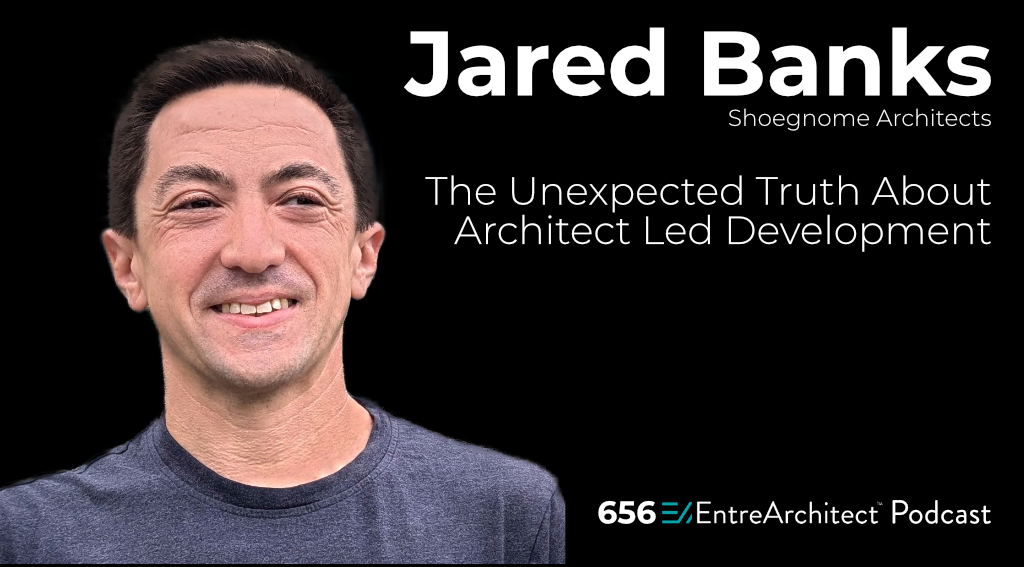
In Episode 656, I sat down again with Jared Banks, the founder of Shoegnome Architects, to talk about what happens when that idea becomes reality. This is not a theoretical conversation about architect-led development. This is a real story, with real risk, real money, and real consequences.
If you’ve ever considered becoming an architect as developer, this is a conversation worth your time.
Listen to the full episode here: https://entrearchitect.com/656
The Idea That Slowly Becomes Inevitable
What struck me most about Jared’s story is that it didn’t begin with a bold, calculated move. It started the way many important things do, with conversations. Over time, those conversations evolved into curiosity, and that curiosity eventually became action.
A friend purchased a property. They talked about the process. They explored the idea of doing it together. For years, nothing happened. Then one day, the right opportunity appeared, and they were ready to act.
They made an offer. They got the property.
That’s often how these things happen. Not through a perfect plan, but through a series of small decisions that lead to a moment where you either move forward or you don’t.
You’re Not Adding a Skill, You’re Starting a Business
One of the biggest misconceptions about architect-led development is that it’s simply an extension of what we already do. It feels like a natural progression. You already understand design, construction, and coordination, so how hard could it be to take on ownership?
What Jared discovered is that development is not an add-on. It is a second business.
For more than three years, he wasn’t just running an architecture firm. He was running a development company at the same time. Each demanded attention, decision-making, and accountability. The mental load alone was significant, and unlike a traditional project, there was no client to guide the direction.
You become the client.
That means every uncertainty, every delay, and every financial decision rests with you. It’s a completely different level of responsibility, and it requires a different mindset than most architects are used to operating within.
The Cost of Being Too Collaborative
Early in the project, the partnership worked the way many small firm teams operate. Everyone was respectful. Everyone contributed. Decisions were shared. It felt like a healthy collaboration.
But something was missing.
No one was driving the process.
Without a clear leader responsible for pushing decisions forward, timelines stretched. What could have taken a few months extended into nearly a year before permits were even submitted. It wasn’t because of incompetence or lack of effort. It was simply the absence of urgency.
That’s a hard lesson to learn, but an important one to carry forward.
In development, collaboration is valuable, but leadership is essential. Someone must own the schedule, push decisions, and move the project forward. Without that, the project drifts, and every day of delay has a financial cost attached to it.
Financing Is Where the Real Risk Lives
Most architects underestimate the financial complexity of development. It’s easy to imagine funding a project once it’s successful, but the reality is that you must carry the risk long before you ever see a return.
In this case, the partners used personal resources to acquire the property. That included leveraging home equity and taking on personal guarantees. Spouses were involved. The risk extended beyond the business and into their personal lives.
At one point, they nearly entered into a loan agreement that could have created serious long-term consequences. It was only avoided because someone took the time to carefully review the terms and recognize the danger.
That moment highlights a critical truth.
In development, financial literacy is just as important as design skills. The decisions you make around funding, loans, and structure can define the outcome before construction even begins.
When Good Design Meets Market Reality
As architects, we believe that thoughtful design leads to better outcomes. We invest time in creating spaces that are balanced, equitable, and intentional. In this project, that philosophy guided many of the design decisions.
The units were carefully planned to feel equal in value. Bedrooms were similar in size and quality. The goal was to create a consistent experience across all four homes.
From an architectural standpoint, it made sense.
From a market standpoint, it created challenges.
Buyers were looking for differences. They wanted options. They wanted to compare one unit to another and understand why one might be more valuable than the next. Instead, they were presented with a single idea expressed four times with only minor variations.
That made the sales process more difficult than expected.
This is one of the most humbling aspects of development. You are no longer designing for a specific client. You are designing for a market, and that market doesn’t always value the same things you do.
The Plan That Didn’t Work
The original strategy was straightforward. Build the townhouses, bring them to market, sell them quickly, and realize the return. That model had worked in the past, and there was no reason to believe it wouldn’t work again.
But timing changed everything.
The project was completed in late 2025, at a moment when interest rates were high and buyer confidence had slowed. Townhouses in that market were not moving, and despite being ready to sell, the units sat.
After several months, the team made a difficult decision.
They pulled the properties from the market and shifted to rentals.
Adapting When the Market Forces Your Hand
Becoming landlords was never part of the original plan. Like many architects exploring development, the goal was to build, sell, and move on. Instead, they found themselves managing tenants, maintaining the property, and navigating an entirely new business model.
The transition happened quickly, and in many ways, it worked. The units rented fast, which confirmed that the product had value. But financially, the situation was more complex.
The rental income covered most of the expenses, but not all. Each month required additional contributions from the partners to keep the business stable. That meant continuing to invest in a project that was supposed to have already returned capital.
This is the reality of development.
Even when you do everything right, external forces can shift the outcome. Your ability to adapt becomes just as important as your original plan.
Playing the Long Game
Despite the challenges, the project still holds significant value. The buildings exist. The debt is being reduced over time. The market will eventually adjust, and opportunities to sell will return.
The question now is not whether the project has value, but whether the partners can hold it long enough to realize that value.
That’s a different kind of decision.
Development often requires patience, and sometimes that patience is forced upon you. What begins as a short-term investment can become a long-term strategy, and your ability to sustain that shift determines your outcome.
Why It Was Still Worth It
When I asked Jared if he would do it again, his answer was thoughtful. He didn’t rush to say yes, but he didn’t hesitate to acknowledge the value of the experience.
This project changed him.
He now understands the business side of architecture at a deeper level. He has experienced what it means to be the client, to make decisions without a safety net, and to carry the weight of those decisions over time. He has navigated construction, financing, and operations in a way that few architects ever do.
That kind of experience is difficult to measure, but it’s incredibly valuable.
Even if the financial outcome is neutral, the growth is significant.
Lessons You Can Apply Right Now
You don’t need to become a developer to benefit from this story. There are practical lessons here that apply directly to your firm today.
If you ever pursue development, do it with partners. The emotional and financial demands are too great to carry alone, and the right partners provide both support and perspective.
Define roles clearly from the beginning. Identify who is leading the business, who is responsible for decisions, and how those decisions will be made. Clarity early prevents confusion later.
Formalize your agreements. Not because you expect conflict, but because you want to protect the relationship and ensure that everyone is treated fairly.
Understand your market. Design matters, but the market determines value, and your success depends on aligning the two.
A Different Path Forward
Architect as developer is not for everyone. It requires a tolerance for risk, a willingness to take on responsibility, and the ability to navigate uncertainty without guarantees.
But for those who are willing to pursue it, the rewards go far beyond financial return.
It changes how you think. It changes how you practice. And it gives you a level of control and understanding that is difficult to achieve any other way.
If you’re curious, start by learning. Talk to people who have done it. Study the numbers. Understand the risks before you take them.
Then decide if it’s the right path for you.
Because once you step into that role, you are no longer just an architect. You are building something much bigger than a project.
Listen to the full episode here: https://entrearchitect.com/656

Leave a Reply