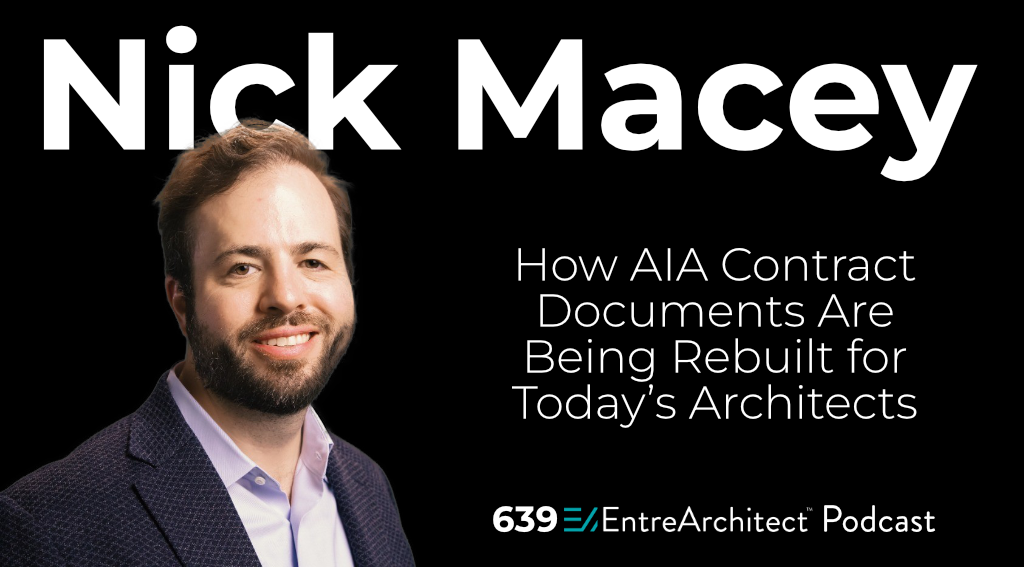
CEO Nick Macey on clarity, risk, and modern contract intelligence for small firms
This week on the EntreArchitect Podcast, I sat down with Nick Macey, CEO of AIA Contract Documents, for a timely and important conversation about risk, clarity, and the future of contracts in architectural practice.
If you run a small firm, this episode matters.
Contracts are one of those topics many architects avoid until something goes wrong. Yet they quietly shape almost every outcome in our businesses. Nick and I talked candidly about how the market has changed, why contracts matter more than ever, and how AIA Contract Documents is being rebuilt to better serve firms of every size.
What follows are my key takeaways and lessons from that conversation, especially for small firm architects who want to build more resilient, predictable, and profitable practices.
From Paper to Platform
I have been using AIA contracts for decades. I remember paper copies, red pens, copy machines, and binders stuffed with forms that only came out when there was a problem. That history matters, because it explains why so many architects still associate AIA contracts with complexity and friction.
Nick acknowledged that reality directly.
The early digital transition was hard. The tools were complicated. The workflows were memorized rather than intuitive. For many architects, the experience reinforced the belief that contracts were a necessary evil rather than a strategic asset.
What struck me most is how intentionally AIA Contract Documents has worked to reverse that perception.
Today, the platform is designed around projects, not documents. Agreements are organized, searchable, and connected across the life of a project. The interface is simpler. Templates can be reused. Teams can see what has changed, when it changed, and why it changed.
This is not about making contracts flashy. It is about making them usable.
Why the Market Makes Contracts Even More Important
Nick shared data that mirrors what many of us are feeling. Architecture billings have been contracting. Demand has softened. Pressure shows up fast for small firms, especially around cash flow, scope creep, and client expectations.
In that environment, contracts are no longer just legal protection. They become stabilizing systems.
A well structured agreement does three critical things:
It sets expectations early.
It creates predictability when conditions change.
It provides clarity when pressure is high.
Nick framed contracts not as defensive tools, but as alignment tools. That reframing matters. When margins are tight and projects are fewer, misunderstandings are more expensive. Clear agreements reduce friction before it starts.
Digital Trust and the Certification Advantage
One of the most important points Nick made was about trust.
In the past, it was easy for documents to drift. Old versions. Photocopied forms. Word documents with tracked changes buried three layers deep. Architects were often told a document was “based on” an AIA contract without knowing what had been altered.
The modern platform changes that.
The certification and redline process makes every change visible. Everyone can see deviations from the standard language. Nothing is hidden. That transparency builds trust among owners, architects, and contractors.
For small firms, this is especially important. You may not have in house legal counsel reviewing every document. Visibility becomes your safety net.
Contracts Should Live With the Project
One of my frustrations as a practicing architect was how contracts disappeared after signing. They were filed away and only resurfaced when there was conflict.
Nick described how the new system is designed to keep agreements accessible throughout the project lifecycle. Documents are tied to projects. Search makes retrieval easy. Integrations are being built to bring contract intelligence closer to daily workflows.
Even more compelling is where this is headed.
AIA Contract Documents is working on AI driven tools that allow firms to query their contract history, compare risk across projects, and quickly find relevant provisions. The goal is not to replace judgment, but to surface information faster and more intelligently.
This is contract intelligence, not contract automation.
AI With Guardrails
We talked directly about artificial intelligence. Many architects are already using AI to draft language or summarize documents. Nick was clear about the opportunity and the risk.
Contracts exist to protect you. Randomly generated language without legal grounding or case law history can expose firms to unnecessary risk.
The approach AIA Contract Documents is taking is thoughtful. AI is being used to guide users toward approved language, relevant alternatives, and context based recommendations drawn from the existing body of AIA documents.
This is not about inventing new clauses. It is about helping architects make better informed decisions using language that has already been tested and trusted.
For small firms, this could be transformative. It lowers the barrier to using the right document for the right project without sacrificing protection.
Small Firms Are Not an Afterthought
One of the most important clarifications Nick shared is that AIA Contract Documents are not only for large or complex projects.
There are documents specifically designed for small and simple projects, including agreements that are only a few pages long. These forms still provide professional grade protection, but without unnecessary complexity.
Many small firm architects either avoid contracts altogether or reuse outdated documents because they believe the AIA system is overkill. That belief is outdated.
There is a document for almost every use case. The challenge is awareness, not availability.
Subscription Access Changes Behavior
Nick explained the two access models. Single document purchases and subscription access.
While both exist, he strongly encouraged subscription use.
When firms subscribe, they stop thinking of contracts as one time events and start using them as systems. They use the right forms at the right time. They incorporate change orders, payments, and project administration documents consistently.
That consistency reduces risk and improves outcomes. For small firms, it also saves time and mental energy.
Support Still Matters
One thing I appreciated hearing is that there are still real humans behind the platform.
Support is available by phone, chat, and email. Demos are easy to schedule. Learning resources are accessible. This matters, especially for architects who have been burned by poor software support in the past.
Technology alone does not create confidence. Support does.
One Action Every Small Firm Architect Should Take
When I asked Nick what one thing small firm architects can do today to build a better business for tomorrow, his answer was simple and powerful.
Focus on agreements.
Take time to review how you set expectations at the beginning of projects. Ask whether your current agreements truly reflect how you work today. Make sure your contracts support clarity, trust, and alignment before problems arise.
That work pays dividends far beyond risk management. It frees your time. It reduces friction. It allows you to focus on design, leadership, and growth.
If you want to hear the full conversation with Nick Macey, I strongly encourage you to listen to the complete episode of the EntreArchitect Podcast at: https://entrearchitect.com/639
This is one of those episodes that can quietly change how you run your firm, starting with the documents you use every day.
Leave a Reply