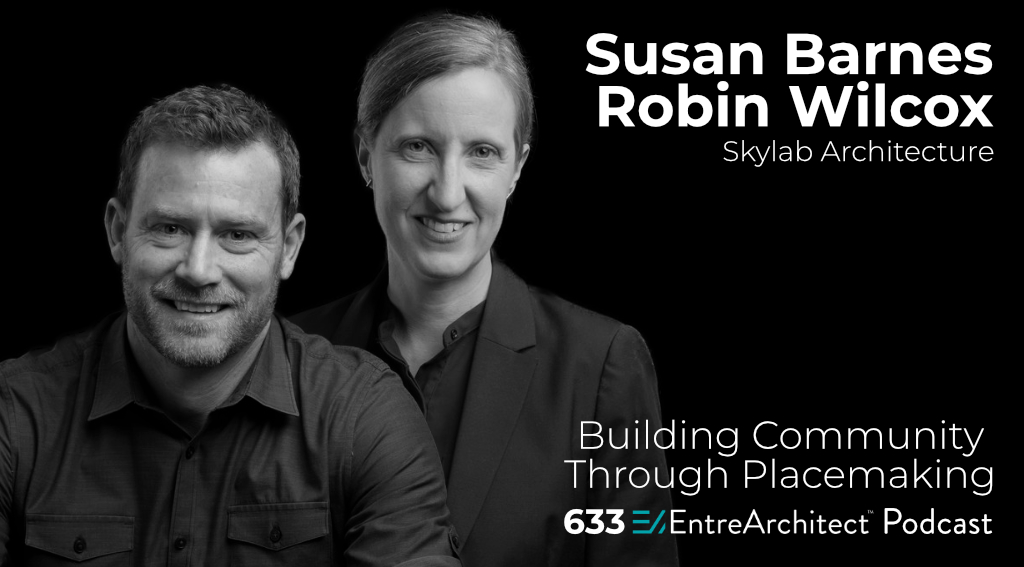
In this week’s episode of EntreArchitect Podcast, I sat down with Susan Barnes and Robin Wilcox of Skylab Architecture, a Portland-based firm known for crafting designs that honor legacy and landscape while driving long-term value for clients and communities.
Our conversation explored how Skylab approaches placemaking—the art and business of creating spaces that feel authentic to their surroundings and meaningful to the people who inhabit them. From the Nike World Headquarters Serena Williams Building to large-scale master plans in Deer Valley, Telluride, and Alaska, Susan and Robin have developed a philosophy rooted in story, collaboration, and holistic design.
They’ve found that good architecture isn’t just about form or aesthetics. It’s about aligning the story of place with the goals of clients and communities—and doing so with creativity, strategy, and respect for the environment.
The Story Behind the Designers
Susan Barnes grew up surrounded by creativity. Her father was a packaging engineer who dreamed of becoming an architect. His fascination with materials, design, and problem-solving influenced her early view of how things come together. After studying architecture at the University of Michigan, Susan built a career through some of the most design-driven firms on the West Coast before finding her professional home at Skylab nearly 15 years ago.
Robin Wilcox took a different route. With both parents in education, his introduction to architecture came from exploring the campus of Kansas State University as a kid—wandering through halls, peeking into studios, and discovering the joy of buildings as living environments. He later studied at the University of Oregon, worked with small and large firms, and eventually joined Skylab after receiving a call from Susan to collaborate on the ambitious Serena Williams Building at Nike.
That project became a turning point for both. The scale, complexity, and collaborative process deepened their understanding of leadership, team building, and what it means to manage a vision that extends far beyond a single building.
The Skylab Philosophy: A Holistic Lens
What sets Skylab apart is its integrated approach. The firm combines architecture, interiors, and master planning with an understanding of development, construction, and branding. Susan describes it as “a creative agency mindset applied to architecture.”
Projects begin not with drawings, but with dialogue—researching the art and science of place. That means studying geology, culture, and community alongside budgets, operations, and client goals.
Robin explained that this process is part discovery and part storytelling. “We start broad,” he said. “We look at the watershed, the animal species, the cultural history—everything that defines that environment. Then we distill it into a story that becomes the guiding light for the entire project.”
That story, once embraced by the client, serves as the foundation for every decision—materials, details, spatial organization, and even community engagement. When value engineering inevitably arises, that shared narrative keeps everyone focused on what matters most.
Defining Placemaking
When Skylab talks about placemaking, they’re not referring to trendy urban design jargon. They’re describing a philosophy of design that connects architecture to people and place in tangible ways.
Susan explained that their work always begins with “searching for that undiscovered moment” that makes a place feel alive. Every project, from a single-family home to a mountain resort, is treated as an opportunity to create something unique and meaningful.
For Robin, placemaking also means ensuring that projects respond to both the natural environment and the economic realities that shape them. “We’re always balancing design vision with business sense,” he said. “That’s how we create value that lasts.”
Listening to the Land and the People
Two recent projects—Deer Valley in Utah and Alyeska in Girdwood, Alaska—illustrate Skylab’s approach to large-scale placemaking.
At Deer Valley, the team is reimagining a new base village that will transform the existing ski resort into a four-season destination. The goal is to create a modern mountain community that preserves parking and access for local skiers while inviting everyone—residents, tourists, and workers—to gather in a pedestrian-friendly environment that feels both intimate and timeless.
Susan described the process as one of “listening and responding,” balancing the resort’s development goals with feedback from the local community. “We made real changes based on community input,” she said. “It keeps getting better as more voices are included.”
In Alaska, the Alyeska master plan presented both design and logistical challenges. Built around an existing hotel in a northern rainforest valley, the project integrates new housing, retail, and recreation spaces—all while addressing workforce housing shortages that are critical in resort towns.
Robin shared how the design drew inspiration from the surrounding Chugach Mountains. “We looked at the landscape as layers—from wetlands to forest canopy to alpine peaks—and used those strata as a metaphor for how the buildings are composed,” he explained. “The result is a village that feels like it grew naturally from the terrain.”
Managing Complexity with Creativity
Projects of this scale require years of planning—often five to eight years from initial vision to construction. The coordination among architects, engineers, landscape architects, and clients is immense.
Skylab’s integrated structure gives them an advantage. With architects, interior designers, fabrication specialists, and brand strategists all working under one roof, the firm can move quickly, maintain consistency, and deliver a cohesive experience.
That unity translates into economic efficiency. “There’s real value in having a single design vision,” Robin said. “It saves time, reduces management overhead, and lets us make better decisions faster.”
But Susan and Robin emphasized that success also depends on partnerships—working with consultants and contractors who share the same goals and understand the firm’s commitment to quality and innovation.
Innovation Grounded in Story
Throughout our conversation, one theme kept emerging: storytelling as a framework for innovation.
Whether designing a million-square-foot corporate campus or a small Kwanzaa hut in California, Susan and Robin approach every project through narrative—asking what the place wants to say and how the architecture can express it.
That approach keeps their work grounded while encouraging experimentation. It’s why Skylab has been able to expand into such diverse sectors: hospitality, residential, retail, commercial, mountain resorts, and even the upper decks of cruise ships.
As Susan put it, “Our saying around here is, ‘Yes, we can do that.’ We use our foundational process, but always look for where we need to grow.”
Designing for Human Connection
For all the scale and sophistication of their work, Skylab’s success still comes down to people—clients, communities, and collaborators.
Robin believes that maintaining strong relationships is the foundation of their business. “So much of our work comes from relationships we’ve built over the years,” he said. “In times of uncertainty, that focus on connection becomes even more important.”
Susan added that their creative energy comes from staying open—open to new project types, new ideas, and new ways of seeing the world. “We want every project to make the place better than we found it,” she said.
That’s what placemaking really means at Skylab. It’s not about style or scale—it’s about stewardship.
Lessons for Small Firm Architects
There’s a lot small firm architects can learn from Skylab’s example.
First, embrace the storytelling process. Even if your projects are modest in scale, every client, every site, and every problem has a story waiting to be told. Discover it, refine it, and use it as your guiding light.
Second, think holistically. Whether you handle interiors, branding, or community engagement yourself, look at the project as a complete experience. Integrate design, function, and emotion.
Third, invest in relationships. Like Skylab, your future work depends on the trust you build today.
And finally, stay open to possibility. As Susan said, “Always think of every project as being on an equal plane of execution and excellence.”
That mindset—curiosity paired with craftsmanship—is what transforms an architect into a true placemaker.
To hear the full conversation with Susan Barnes and Robin Wilcox of Skylab Architecture, listen to EntreArchitect Podcast Episode 633.

Leave a Reply