How understanding the building process improves your designs, strengthens contractor relationships, and creates a more valuable architecture firm.
Most architects spend years learning how to design buildings before they ever experience what it takes to construct one. We study design principles, develop technical drawings, learn building systems, and eventually become responsible for decisions that affect how buildings are assembled. Yet many of us enter the profession with very little firsthand experience on a construction site.
That disconnect creates a significant challenge for our profession. We are trained to design buildings, but we are not necessarily trained to understand the people, processes, and practical realities involved in building them.
I believe construction experience should be an essential part of every architect’s professional development. Not because every architect needs to become a contractor, but because understanding how buildings are actually constructed makes us better at everything we do.
For small firm owners, that understanding can become a meaningful competitive advantage. It improves the quality of our work, strengthens our relationships with contractors, helps us manage client expectations, and creates opportunities to deliver greater value.
The Gap Between Knowing How to Design and Knowing How to Build
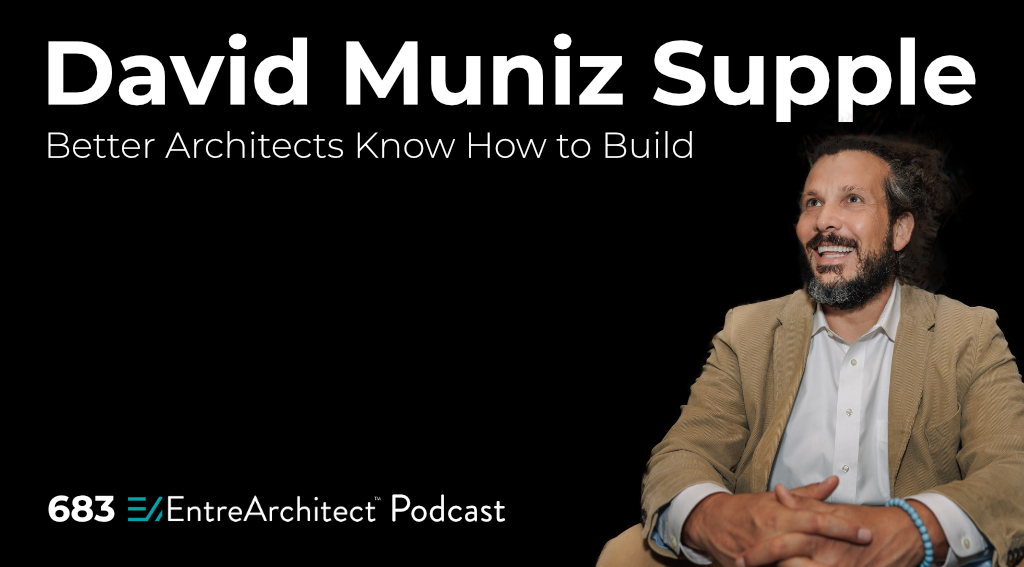
During a recent conversation on the EntreArchitect Podcast, I spoke with David Muniz Supple, founder and CEO of New England Design and Construction, an integrated design-build firm in Massachusetts.
David shared an experience from early in his architectural career that illustrates a problem many architects encounter. While working late at an international architecture firm, he received a call from a contractor who needed clarification on a construction detail. David opened the drawing but realized he didn’t fully understand what he was looking at. The contractor needed an immediate answer to continue working, and David couldn’t provide one.
That experience exposed a gap in his professional knowledge. He could produce architectural drawings, but he didn’t yet understand enough about construction to confidently explain how those drawings should be executed.
Rather than accept that limitation, David decided to do something about it. He left architectural practice temporarily and went to work as a carpenter. That decision eventually helped shape the integrated design-build business he leads today.
David’s experience raises an important question for every architect: How can we confidently design something if we don’t fully understand how it will be built?
Architectural education provides an important foundation, but construction knowledge develops through exposure to the actual building process. There is a difference between understanding a wall section on paper and watching a carpenter assemble that wall under real jobsite conditions. Both forms of knowledge matter, and the strongest architects develop both.
Construction Experience Changes How You Design
When architects understand construction, they approach design decisions differently. A detail is no longer simply a collection of lines representing materials and connections. It becomes a sequence of activities performed by people using tools, equipment, and materials under specific conditions.
You begin asking different questions. Can the contractor actually access this connection? How will the materials be installed? Does the proposed assembly create unnecessary complexity? What happens when the dimensions on the drawings don’t perfectly match existing conditions?
These questions influence design quality long before construction begins.
Consider a residential renovation involving a new addition to an existing house. An architect might develop an elegant connection between the new roof and the existing structure. The drawings may communicate the design intent clearly, but construction experience helps the architect anticipate additional challenges.
How will the contractor protect the existing building during demolition? What conditions might be discovered when the existing roof is opened? How will the framing sequence affect the ability to maintain a weather-tight enclosure?
Understanding these issues doesn’t mean compromising the design. It means developing a design that responds intelligently to the realities of construction.
For small firms, this knowledge is especially valuable because owners frequently serve as principal designer, project manager, and primary client contact. Better construction knowledge improves decisions across all three responsibilities.
Understanding Builders Makes You a Better Collaborator
Construction experience provides something equally important to technical knowledge. It helps architects understand how builders think.
Architects and contractors approach projects from different perspectives. Architects are responsible for developing and communicating the design. Contractors must translate that information into a physical building while managing labor, materials, schedules, subcontractors, and financial risk.
Neither perspective is complete without the other.
Unfortunately, our industry has developed a culture in which architects and contractors sometimes approach their relationship as opposing sides. Questions become challenges to authority. Requests for clarification become frustrations. Problems that should be solved collaboratively become opportunities to assign blame.
That relationship does not serve our clients, our businesses, or the buildings we create. Spending meaningful time working alongside builders changes that dynamic.
When you understand the pressures contractors face, you become better equipped to communicate with them. You recognize why certain details create difficulties, why sequencing matters, and why apparently minor design changes can produce significant consequences in the field.
You also develop credibility. A contractor who recognizes that an architect understands construction is more likely to engage in productive technical conversations. That mutual respect creates opportunities to solve problems before they become expensive disputes.
For small firm owners, strong relationships with reliable contractors can become some of the most valuable professional relationships you develop. These relationships improve project delivery, support more accurate budgeting, and can lead to referrals and future opportunities.
Bring Construction Knowledge Into the Design Process
One of the most practical lessons from my conversation with David was how his firm incorporates construction experience into the development of its designers.
At New England Design and Construction, designers are expected to gain firsthand exposure to the different phases of construction. The company has broken its typical projects into approximately 50 to 60 phases. Designers evaluate their experience and identify the areas where they lack sufficient understanding. Those gaps become opportunities for direct observation and participation on construction sites.
This is a powerful approach because it turns construction education into an intentional professional development system. Rather than assuming employees will eventually learn through experience, the firm identifies specific knowledge gaps and creates opportunities to address them.
Most small architecture firms don’t operate their own construction divisions, but that doesn’t prevent them from adopting a similar strategy.
Start by identifying the construction activities most relevant to your practice. If your firm specializes in residential renovations, those might include demolition, foundation work, framing, waterproofing, mechanical rough-ins, insulation, and finish installation.
If you primarily design commercial interiors, your priorities may include existing-condition investigations, partition construction, mechanical coordination, fire-rated assemblies, and finish installation.
Then create opportunities for your team to experience those activities firsthand. You might arrange regular site visits with trusted contractors, schedule field observations during critical construction phases, or invite trade professionals to explain how particular assemblies are installed.
The objective is not simply to visit construction sites. It is to develop specific knowledge that improves future design decisions.
After each visit, ask your team to identify what they learned, what surprised them, and how that information might change their approach to detailing or documentation. Over time, those observations can become part of your firm’s collective knowledge.
Better Construction Knowledge Leads to Better Cost Decisions
Architects have an enormous influence on construction costs, even when they are not responsible for preparing estimates or managing construction contracts.
Every material selection, structural decision, building configuration, and construction detail affects the resources required to complete a project. Yet traditional architectural practice often separates design development from meaningful construction cost feedback.
A client may spend months reviewing drawings, renderings, and material selections before receiving a contractor’s estimate that reveals the project is substantially beyond their budget.
At that point, the architect and client face difficult choices. They can reduce the scope, compromise important design priorities, increase the budget, or return to earlier design decisions. Each option creates additional work, frustration, and potentially damaged relationships.
David’s design-build firm approaches this challenge differently.
His team introduces construction cost information throughout the design process. As the project develops, clients review both the evolving design and its anticipated cost. This allows clients to make informed decisions while changes are still relatively inexpensive to implement.
David describes the objective as making significant project changes during design rather than construction. That principle applies to every architecture firm, regardless of its delivery model.
You don’t need to become a design-build contractor to incorporate construction cost knowledge into your design process. You can establish relationships with contractors who provide preliminary pricing, involve trade professionals when evaluating complex assemblies, and develop internal cost benchmarks based on completed projects.
You can also establish clear budget checkpoints during schematic design and design development. The important distinction is that construction cost should influence design decisions while those decisions are being made, not simply evaluate them after the design is complete.
When architects help clients understand the financial consequences of their choices, they provide a more valuable professional service.
You Don’t Need to Become a Design-Build Firm
David is passionate about reconnecting architecture and construction. He believes architects should reclaim the traditional role of master builder, a role that historically combined responsibility for design with a deep understanding of building.
His own company represents one approach to achieving that integration. New England Design and Construction provides both architectural design and construction services within a single business. The firm designs the projects it builds and develops construction pricing alongside the architectural design.
But David also recognizes that integration can take different forms.
Architects can work more closely with contractors during preconstruction. They can develop collaborative relationships with builders and specialty trades. They can incorporate construction expertise into their design teams without assuming responsibility for construction.
The important lesson is that integration is not necessarily a business model. It is a way of approaching the work.
For entrepreneur architects, this distinction matters. Launching a construction division introduces significant responsibilities involving licensing, insurance, contracts, personnel, cash flow, and risk management. Those responsibilities require careful evaluation before making such a substantial change to your business.
You may discover that your firm can deliver many of the benefits of integrated practice through stronger partnerships and better internal processes.
The goal should not be to adopt a particular business model simply because it works for another firm. The goal should be to identify how your business can deliver better results for its clients.
Make Construction Experience Part of Your Firm’s Culture
If construction knowledge makes architects more effective, we should stop treating it as something employees acquire accidentally over the course of their careers. Instead, make it part of how your firm operates.
Start by evaluating the construction experience of everyone on your team, including yourself. Identify the systems, materials, and processes your firm regularly designs but may not fully understand.
Choose one area where greater knowledge would make an immediate difference.
Perhaps your team frequently struggles with waterproofing details. Arrange a meeting with a contractor who specializes in building-envelope construction. Review actual installation methods, common failures, and the information contractors need from your drawings.
Then apply that knowledge to your next project.
You might also establish a recurring construction learning session. Once a month, invite a builder or trade professional to walk your team through a particular construction process.
Encourage your employees to ask questions and challenge assumptions. Make it clear that identifying something they don’t understand is an opportunity for professional growth, not a weakness.
Most importantly, connect these experiences to the work your firm produces.
Update standard details when you discover better approaches. Improve specifications when you learn about material limitations. Adjust project schedules when you understand how particular construction sequences affect delivery.
This is how construction experience becomes a business asset rather than simply another educational activity. The knowledge becomes part of your firm’s systems, improves consistency, and creates value that extends beyond any individual employee.
The Future Belongs to Architects Who Understand the Whole Process
Technology continues to change how buildings are designed and constructed. Digital fabrication, automation, robotics, and increasingly sophisticated modeling tools are creating new opportunities to connect design information directly with construction activities.
As those connections become stronger, architects who understand both design and construction will be better positioned to participate in decisions that shape the built environment.
But we don’t need to wait for new technology to begin closing the gap. We can start today by strengthening relationships with builders, creating opportunities for firsthand construction experience, and incorporating practical building knowledge into our design processes.
For small firm owners, this is about more than improving technical skills. It is about building a practice that clients trust, contractors respect, and employees are proud to be part of.
The most valuable architects are not necessarily those who know how to design the most complicated buildings. They are those who understand how to turn thoughtful designs into successful built projects.
Consider one question this week: What part of the construction process does your firm need to understand better?
Identify that gap, connect with someone who has the expertise, and create an opportunity to learn. One practical improvement can strengthen your next project and become the foundation for a better way of practicing architecture.
For more on the relationship between architecture and construction, listen to my full conversation with David Muniz Supple on EntreArchitect Podcast Episode 683. We discuss the history of the master builder, the business of design-build, and how architects can reclaim a more integrated role in creating the built environment.
Listen to Episode 683: https://entrearchitect.com/683

Leave a Reply