There are moments in every architect’s life when something shifts. Not a project. Not a client. Not even a breakthrough idea. Something deeper. A realization that this profession is not just about buildings, but about how we think, how we see the world, and how we choose to live.
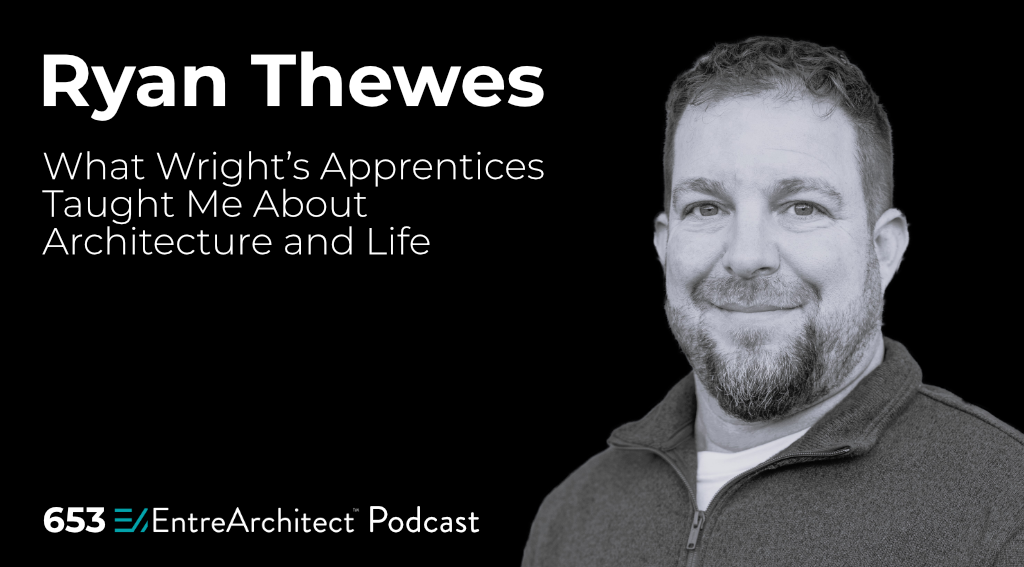
For Ryan Thewes, that realization didn’t arrive all at once. It unfolded slowly over time through a series of decisions, risks, and relationships that shaped not only his work, but his entire perspective on architecture. His story is not just about becoming an architect. It is about pursuing mastery and discovering what it really means to carry a legacy forward.
Discovering the Path Before You Understand It
Ryan grew up in a small town in southern Indiana. He had a natural talent for drawing, and like many young creatives, the people around him pointed him toward architecture. It was a simple suggestion, but it gave him direction. By middle school, he had decided that architecture would be his path.
What he didn’t yet understand was what that path actually required.
When he arrived at Ball State, he quickly realized that architecture was not about drawing. It was about thinking. It was about problem solving. It was about creativity in a way that had nothing to do with how well you could sketch. For many students, that realization is discouraging. It reveals a gap between expectation and reality that is difficult to overcome.
For Ryan, it had the opposite effect. It pulled him deeper into the work.
The Moment Everything Changed
Early in his education, Ryan was assigned a project to design a research center in a swamp. Searching for inspiration, he came across an image of Fallingwater. Like many of us, he had seen the building before, but this time was different. This time, he tried to understand it.
He sat down and attempted to draw it. He couldn’t.
Not because he lacked the skill, but because he lacked the understanding. The building was too complex. Too layered. Too intentional. It wasn’t something you could simply replicate by looking at it. It required a deeper level of thinking.
That moment became a turning point.
Ryan went to the library and began studying everything he could find about Fallingwater. Plans, sections, elevations. He wasn’t just looking at the building anymore. He was trying to understand how it was conceived.
That curiosity led him to Frank Lloyd Wright. But more importantly, it led him beyond Wright.
Chasing the Source
Ryan became fascinated not only with Wright’s work, but with the people who had worked directly with him. The apprentices. The ones who had learned through experience, not theory. The ones who carried those ideas into the next generation.
At a time when this lineage was not being emphasized in schools, Ryan took it upon himself to seek it out. He mailed letters. He made phone calls. He followed leads. He refused to wait for opportunity to find him.
Eventually, that persistence led him to Don Erickson, a Taliesin apprentice based in Chicago.
What followed was not just an internship. It was an apprenticeship in the truest sense of the word.
Learning by Doing
Working with Don Erickson was intense. Ryan would sit at the drafting table while Don stood behind him, watching every move. Every line was questioned. Every decision had to be justified.
Why is that line there? Why is it that size? How will this actually be built?
This was not abstract learning. It was practical, immediate, and deeply connected to the reality of construction. Ryan was not just drawing. He was learning how buildings come together, piece by piece.
The experience was challenging, even stressful at times, but it was transformative. It reflected the core principle of Taliesin, learning by doing. Not just imagining architecture, but understanding it at a level where every decision matters.
The Energy of Commitment
There was something else happening during this time that Ryan didn’t expect. Don, who had been dealing with serious health challenges, became energized by Ryan’s presence in the studio. He began showing up earlier, working longer, and engaging more deeply with the work.
Ryan’s commitment reignited something in his mentor.
At one point, Don even let another draftsperson go because Ryan had become such an integral part of the process. It was a powerful reminder that mentorship is not a one-way exchange. When you show up fully, when you care deeply about the work, you contribute in ways that go far beyond your experience level.
Relentless Pursuit
After his time in Chicago, Ryan continued his journey. He worked with Robert Green in Atlanta, another Taliesin apprentice, gaining exposure to a different approach and personality. The experience was quieter, less intense, but still valuable.
Then came another pivotal moment.
Ryan discovered the work of Bart Prince. It resonated with him in a way that felt familiar yet new. It carried the principles he had been studying, but expressed them in a completely different way.
Once again, Ryan reached out. And once again, he refused to accept a passive role in his own future.
When opportunities didn’t immediately appear, he made a bold decision. He packed up everything, moved to Albuquerque, and committed to finding a way to work with Bart Prince.
No guarantees. No safety net. Just conviction.
Eventually, that conviction paid off.
The Discipline of Craft
Working with Bart Prince introduced a new level of complexity. Ryan spent much of his time building physical models, exploring form, structure, and geometry in three dimensions. It was a hands-on process that demanded precision and patience.
This was not about developing a style. It was about refining a way of thinking.
Ryan learned how to translate ideas into physical form, how to solve complex spatial problems, and how to engage with architecture as a craft. It was another step in a long journey of learning, one that reinforced the importance of doing the work, not just studying it.
What was supposed to be a short-term experience turned into several years. Because when you find yourself in the right environment, doing meaningful work, time becomes secondary to growth.
Choosing Your Own Path
Eventually, Ryan and his wife made the decision to move to Nashville. It was a calculated choice. A place with opportunity. A place where he could build something of his own.
He started his practice during a challenging time, just as the economy was heading into recession. But that timing allowed him to establish himself and grow alongside the city as it recovered.
Today, Ryan runs a focused, intentional practice. He does not try to be everything to everyone. He does not chase growth for its own sake. Instead, he concentrates on the type of work he believes in and the kind of practice he wants to lead.
That clarity is not easy to achieve, but it is essential for building a business that aligns with your values.
What This Means for You
Ryan’s story offers a powerful reminder that there is no single path to success in architecture. The traditional route is not the only option. What matters is your willingness to pursue what you believe in, even when it requires risk and uncertainty.
He sought out mentors. He followed his curiosity. He placed himself in environments where he could learn and grow. He took action, again and again, even when the outcome was unclear.
And through that process, he developed not only his skills, but his perspective.
One of the most important lessons he shares is the value of building. Getting out of the studio. Getting your hands dirty. Understanding how your drawings translate into reality. That experience changes the way you design. It deepens your understanding of the work.
It makes you a better architect.
The Legacy Lives On
What makes Ryan’s journey so compelling is the direct connection he built to a lineage that traces back to Frank Lloyd Wright. Not through textbooks, but through people. Through experience. Through doing the work alongside those who had lived it.
That kind of legacy cannot be replicated in a classroom. It has to be experienced. It has to be felt.
And when you hear stories like Ryan Thewes’, you begin to understand that this legacy is not something locked in the past. It is something that continues to evolve through those who choose to pursue it.
An Invitation
Ryan’s story is not about Taliesin, but it makes one thing clear. Places like Taliesin are not just historic sites. They are living expressions of an idea. A way of thinking about architecture that connects design, craft, and purpose.
You can read about that idea. You can study the drawings. You can admire the photographs. But at some point, if you are serious about the work, you need to experience it for yourself.
This year, we have that opportunity.
The Taliesin Experience is now open to everyone. It is a chance to walk the grounds, see the architecture up close, and spend time with a community of architects committed to meaningful work.
If Ryan’s journey stirred something in you, pay attention to that. It is the same instinct that led him to seek out the source, to learn from those who came before him, and to build a practice rooted in purpose.
You can learn more and register at entrearchitect.com/taliesin.
Leave a Reply