How integrating architecture, construction, and real estate can transform your firm and increase your value
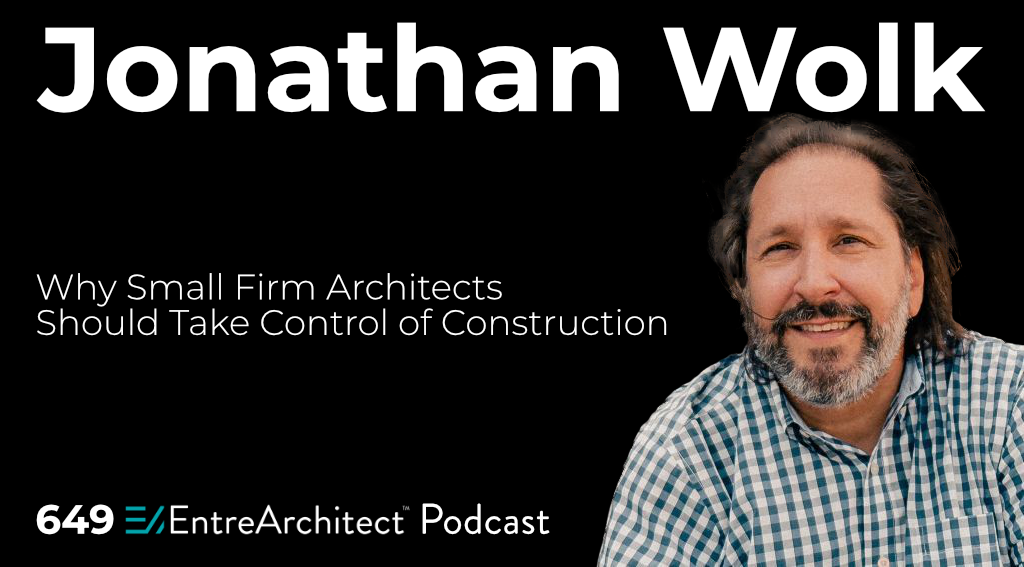
In Episode 649, I sat down with Jonathan Wolk, a licensed architect, general contractor, and real estate broker who has built something most architects only talk about.
An integrated practice that brings architecture, construction, and real estate together under one brand.
If you’ve ever said, “I’d love to build my own work,” this conversation is for you.
Jonathan isn’t theorizing. He’s doing it. And what he shared offers powerful lessons for small firm architects who want more control, more value, and a stronger business.
Architect-Led Design Build Is About Control, Not Ego
There’s a romantic version of design build that many architects imagine.
It looks like creative freedom. Artistic control. The ability to ensure the final product matches the vision.
But what Jonathan described is something much deeper.
Architect-led design build is about alignment.
When architecture, construction, and even real estate are integrated from the beginning, the project benefits from shared goals. No finger pointing. No adversarial posturing. No architect versus contractor dynamic.
Instead of reacting to cost overruns, you’re shaping the budget from day one.
Instead of fighting change orders, you’re preventing them.
Instead of defending your design in the field, you’re collaborating to improve it.
That shift from reaction to proactive leadership is the real opportunity.
The Sooner You’re Involved, The Greater Your Impact
One of Jonathan’s most important insights was simple.
The sooner we’re there, the more impact we have.
If you’re only brought in after a property is purchased, you’re reacting to decisions already made. Zoning limitations, site constraints, orientation issues, budget assumptions. They’re baked in before you even start.
But when you’re involved at acquisition, everything changes.
You can evaluate topography. Access. Utilities. Sun angles. Future expansion potential. High-level construction costs.
That’s not just design thinking.
That’s strategic thinking.
And when you provide that level of guidance, you elevate your role. You’re no longer someone “drawing plans”. You’re a trusted advisor helping shape major financial decisions.
That’s a different level of value.
Two Contracts. One Integrated Experience.
One of the most interesting parts of Jonathan’s model is how he structures the business.
Three separate legal entities. One brand.
The architecture contract and the construction contract are separate. The client writes two checks. But from the client’s perspective, it feels seamless.
That distinction matters.
When design is buried inside a construction contract, it’s often perceived as free. The client believes they’re buying a building and getting drawings along the way.
When design stands on its own, its value increases.
The perceived value increases.
The clarity increases.
And the accountability increases.
For small firms looking to expand into construction, this is critical. Protect the integrity of the architectural service. Don’t hide it inside a lump sum promise.
The Real Advantage Is Feedback in Real Time
The biggest takeaway for me was how powerful real-time feedback becomes when design and construction teams work side by side.
Instead of discovering problems during bidding, you’re solving them during design.
Instead of issuing RFIs, you’re having conversations at the table.
Jonathan described a framing scenario where a small structural change allowed mechanical systems to run more efficiently. That adjustment didn’t compromise the design. It improved constructability and saved time.
That kind of collaboration only happens when trades are engaged early.
It also builds respect.
When subcontractors understand why a detail matters, they execute it differently. They care more. They return to see the finished product.
That culture shift is significant.
It transforms the project from a series of transactions into a shared effort.
Clients Don’t Just Want Design. They Want Confidence.
One of the hidden benefits of architect-led design build is emotional.
Construction creates anxiety.
Unforeseen conditions. Inspector surprises. Budget adjustments. Schedule pressures.
When architecture and construction are disconnected, those anxieties multiply. And too often, the owner becomes the mediator between two professionals arguing over scope.
In an integrated model, that friction is dramatically reduced.
There’s no finger pointing.
There’s no “that’s not my responsibility.”
There’s a team solving problems together.
That level of coordination creates confidence. And confidence builds trust. And trust leads to repeat clients.
The Hard Lessons
Jonathan was candid about mistakes.
He admitted that early on, he allowed artistic ambition to override financial discipline. He over-designed projects where the return on investment didn’t justify the effort.
That lesson is critical.
Design build is still a business.
You cannot sacrifice profitability in pursuit of perfection.
Every square inch does not carry equal importance.
Your responsibility is not to impose your artistic priorities. It’s to understand your client’s priorities and allocate resources accordingly.
This requires maturity.
It requires restraint.
And it requires clarity about what truly matters in each project.
Construction Is Paperwork
Here’s a truth many architects don’t fully appreciate.
Construction is contracts.
It’s scope definition. Clarity in language. Risk management.
A detail on a drawing is not enough.
If a subcontractor’s contract says “install toilet,” and you assumed that meant providing a specific fixture, you may be in for a surprise.
Architect-led design build demands precision beyond design documentation. It requires understanding how words shape responsibility.
If you are considering this path, strengthen your contract literacy. Learn how scopes are defined. Study how subcontractor agreements are structured.
This is not glamorous work.
But it protects your business.
Understanding How Things Go Together
Perhaps my favorite moment in our conversation was Jonathan’s story about slot windows that were beautiful on paper but impossible to build.
That lesson is timeless.
If you don’t understand how drywall is installed, how trusses are lifted, how finishes are applied, you are designing in abstraction.
Great architecture is not just about form.
It’s about execution.
I’ve said this before and I’ll say it again. If you want to become a better architect, go build something. Volunteer with Habitat. Spend time on a job site. Talk to the trades.
The more you understand the physical realities of construction, the better your designs become.
And if you choose to pursue design build, that knowledge becomes foundational.
Should Every Architect Become a Builder?
No.
Jonathan was clear about this.
Some architects are artists. Some are deeply technical. Some thrive in conceptual space. Others are energized by field coordination.
Design build requires a certain mindset.
It requires comfort with risk. With contracts. With scheduling. With financial exposure.
But whether or not you become a builder, you should understand builders.
The more you know about construction, the more leverage you have in any delivery model.
A Strategic Opportunity for Small Firms
For small firm architects, this conversation opens a door.
Construction can be a powerful revenue stream. It can deepen client relationships. It can create competitive differentiation.
But it must be approached strategically.
Not as a hobby.
Not as an ego exercise.
As a disciplined business model.
If you’re curious about architect-led design build, start by strengthening your construction knowledge. Develop relationships with trades. Study contracts. Evaluate your state’s licensing requirements.
And most importantly, ask yourself this question.
Are you prepared to lead?
Because that’s what this model requires.
Leadership from acquisition to ribbon cutting.
If that excites you, Episode 649 is one you don’t want to miss.
Listen to the full conversation at https://entrearchitect.com/649 and consider what integration might look like in your own firm.
There is power in drawing lines.
There is even greater power in building them.
Leave a Reply