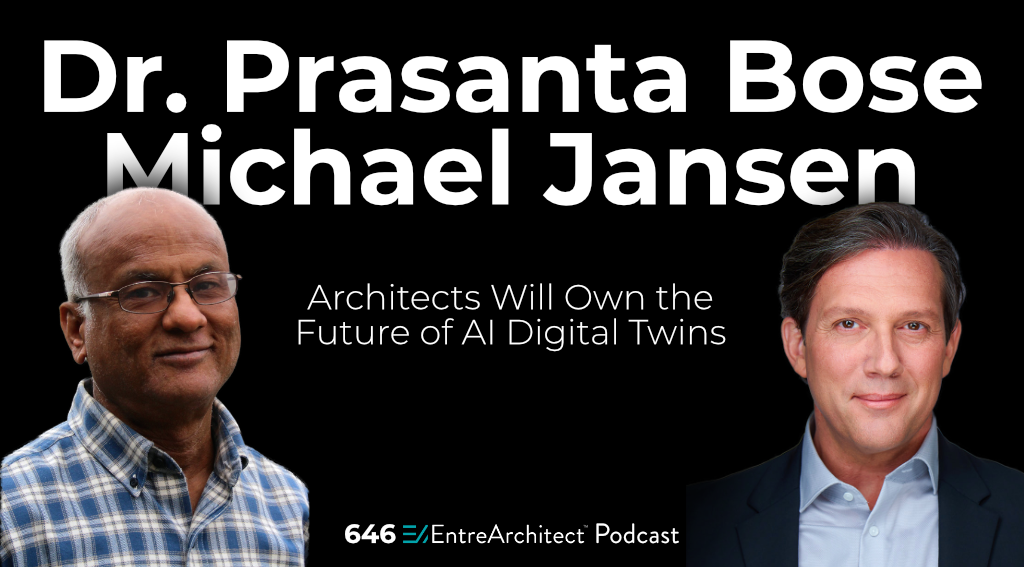
Lessons from a conversation about technology, judgment, and the future of architectural work
I recently sat down with Michael Jansen and Dr. Prasanta Bose for EA646 of the EntreArchitect Podcast. On the surface, the conversation was about AI and digital twins. But the deeper takeaway had very little to do with software.
It was about judgment.
It was about leverage.
And it was about whether architects are willing to evolve how they create value.
This episode didn’t change my mind about where the profession is headed. It confirmed it.
Architects Have Always Managed Complexity
Architects like to say that what we do is complex. That’s true, but it’s also incomplete.
The real skill of architecture is not drawing or modeling. It’s managing tradeoffs. Cost versus quality. Performance versus aesthetics. Speed versus certainty. We do this constantly, often subconsciously.
The problem is that our tools have never matched the way we think.
Most firms still work in silos. Energy modeling lives in one tool. Cost planning in another. Daylighting somewhere else. Compliance tracked manually. We bounce between spreadsheets, plug-ins, consultants, and assumptions.
That disconnect isn’t a failure of architects. It’s a failure of systems.
Digital Twins Are Not About Geometry
One of the most important clarifications in this conversation was what a digital twin actually is.
A digital twin is not a prettier BIM model. It’s a system that understands state, behavior, and change over time. It represents not just what a building looks like, but how it performs, how it ages, and how decisions ripple through it.
That distinction matters because it reframes the role of technology. The value isn’t visualization. The value is feedback.
Architects make hundreds of design decisions long before a building is documented. Most of those decisions are made with partial information. Digital twins move meaningful feedback earlier, when it still matters.
AI Changes the Speed of Learning
I’ve said that AI is not coming for architects. It’s coming for inefficiency.
What AI introduces is not intelligence in the human sense. It introduces speed. It compresses feedback loops that used to take days or weeks into minutes.
During the conversation, what stood out wasn’t the sophistication of the technology. It was the implication. Architects no longer have to choose between exploring ideas and staying on schedule. The old tradeoff between curiosity and efficiency is disappearing.
That’s not about doing more work. It’s about learning faster.
Judgment Becomes More Valuable, Not Less
There’s a quiet fear in the profession that AI will replace architectural thinking. I don’t see that happening. I see the opposite.
As analysis becomes faster and cheaper, judgment becomes more valuable. Someone still has to decide what matters. Someone still has to choose priorities. Someone still has to explain tradeoffs to clients.
AI can surface options. It cannot define purpose.
Architects who understand this will thrive. Architects who confuse production with value will struggle.
Small Firms Have the Most to Gain
This is where my thoughts diverge from much of the industry narrative.
Large firms already have teams for energy, cost, compliance, and performance. Small firms rarely do. That gap has shaped what small firms believe they can compete for.
AI-driven systems narrow that gap dramatically.
When analysis becomes embedded and accessible, small firms can punch above their weight. Not by working harder, but by working smarter. The constraint is no longer staff size. It’s leadership and willingness to adapt.
The Business Opportunity Architects Are Ignoring
One of the strongest implications of this conversation had nothing to do with design.
Architects still walk away from their most valuable asset at the end of construction. We hand over models and move on. The knowledge embedded in those models often dies there.
Digital twins extend the life of architectural thinking. They create opportunities for ongoing services, operational insight, and long-term client relationships.
This is not about selling software. It’s about redefining scope.
If architects want to stop competing on fees alone, they need services that extend beyond drawings. Digital twins make that possible.
Technology Is Forcing a Choice
This is the uncomfortable part.
AI and digital twins won’t transform architecture automatically. They will expose firms that are unwilling to evolve. The technology is neutral. The outcome depends on how it’s used.
Firms that treat AI as a shortcut will miss the point. Firms that use it to deepen thinking, improve decision-making, and strengthen client trust will gain leverage.
The tools are not the strategy. The mindset is.
Why This Matters Now
We are entering a period where owners expect better answers faster. Sustainability, cost certainty, and performance are no longer optional conversations. They are baseline expectations.
Architects who can engage those conversations early, confidently, and intelligently will lead. Those who cannot will be sidelined, regardless of talent.
That’s not a technology problem. It’s a leadership problem.
Final Thought
The conversation with Michael and Prasanta reinforced something I’ve believed for a long time.
The future of architecture belongs to architects who think like systems designers, business owners, and trusted advisors. AI and digital twins are not threats to that future. They are accelerants.
The real question is whether architects are willing to step into that role.
I encourage you to listen to the full conversation and draw your own conclusions.
You can find the full episode here: https://entrearchitect.com/646
Leave a Reply