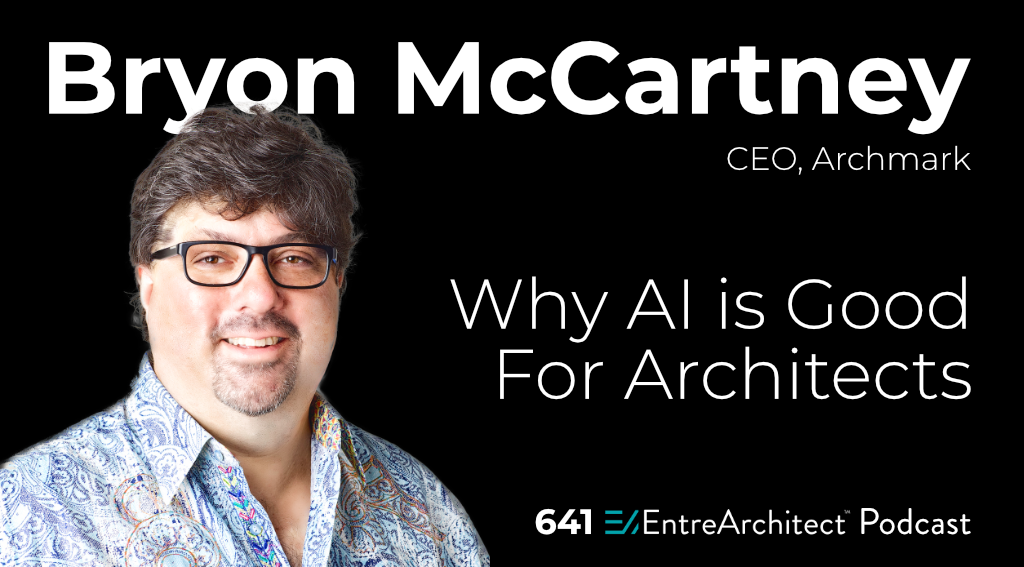
Lessons from Archmark’s Bryon McCartney on using AI to build a better business without losing the human side of architecture
I have known Bryon McCartney for a long time. We have collaborated on conferences, coaching programs, content, and now EntreArchitect Academy. Over the years, one thing has always been true about Bryon. When something captures his attention, he goes all in.
That has never been more evident than with artificial intelligence.
In Episode 641 of the EntreArchitect Podcast, Bryon and I had a wide-ranging conversation about AI, not from the usual hype-driven angle, but from the perspective of real business impact for small architecture firms. This conversation was not about replacing architects with machines. It was about freeing architects from the work that keeps them trapped in their businesses.
What follows are the key lessons and takeaways from that conversation, along with my own reflections on why this matters so much right now for firm owners.
AI Is Not a Design Threat. It Is a Business Opportunity
One of the biggest hurdles architects face with AI is fear. Early conversations around AI focused heavily on design automation, image generation, and the idea that machines might someday replace creative professionals. That framing caused many architects to pull back rather than lean in.
Bryon made a critical distinction that I fully agree with. The real opportunity for AI in architecture is not design replacement. It is business liberation.
Most architects are buried under work that has nothing to do with design. Proposals. Meeting notes. Follow-ups. RFIs. Marketing content. Internal coordination. These tasks are necessary, but they drain energy and time from the work architects actually care about.
AI excels at repeatable, structured, non-creative work. When applied intentionally, it gives firm owners more time for leadership, client relationships, and design thinking. That is not a threat to architecture. It is a competitive advantage.
Architects Struggle with AI Because We Crave Control
Bryon pointed out something that will resonate deeply with many firm owners. Architects are trained problem solvers who value control. We want to understand every system completely before trusting it. AI does not work that way.
AI is learned by use, not study.
You do not master AI by reading about it. You master it by experimenting, iterating, and allowing it to improve over time. That mindset shift is uncomfortable for many architects, especially those who already struggle to delegate work to people.
If you have a hard time delegating to your team, delegating to AI will feel just as difficult. The irony is that AI is often easier to delegate to because it does not get offended, tired, or frustrated. It simply improves with feedback.
The “Too Busy” Trap Is Exactly Why AI Matters
One of the most common objections I hear is, “I am too busy to learn AI.”
Bryon addressed this head-on. If you are too busy, that is the signal that you need AI the most.
Being too busy usually means you are doing too many things manually. It is like saying you are too busy chopping wood to sharpen the axe. AI is the sharpening tool.
The key is not trying to transform your entire firm overnight. Start with one task you hate doing. One task you repeat every week. One task you could explain to an intern in ten minutes.
That is where AI belongs first.
A Simple Framework for Deciding What to Automate
Bryon shared a practical framework his team uses to identify tasks that are ideal for AI. It comes down to five questions.
- Do you clearly understand the task?
- Does the task require your personal expertise?
- Can you explain the task quickly?
- Is the task repeatable?
- Does the task happen frequently?
If a task checks those boxes, it is a strong candidate for AI automation. Meeting notes are a perfect example. So are proposal responses, internal summaries, and content drafts.
You do not need perfection. If AI gets you 80 to 90 percent of the way there, that is a win. The remaining refinement is still far less work than starting from scratch every time.
Real Results from Real AI Integration
This is where the conversation became especially compelling.
Bryon shared that Archmark increased profitability by 174 percent year over year while reducing headcount. That result did not come from working longer hours. It came from redesigning workflows around AI.
Marketing content creation now takes a fraction of the time it once did. Presentations that used to take a week now take a day. Meeting notes automatically generate tasks inside project management software.
This is not theoretical. It is operational.
AI did not remove humans from the business. It removed friction.
AI Implementation Is a Systems Problem, Not a Tool Problem
One of the most important insights from our conversation was that AI adoption fails when firms focus on tools instead of systems.
Downloading software does not change behavior. Systems do.
Bryon is now working with firms specifically on AI implementation, mapping workflows, identifying bottlenecks, and then building AI-supported systems around real work. This mirrors conversations we have had on the podcast about hiring systems champions and documenting processes.
AI works best when layered on top of clear systems. Without that foundation, it becomes another unused app.
Marketing, Follow-Up, and Positioning Are Prime AI Targets
Architects know knowing what to do is not the problem. Execution is.
AI shines in marketing, follow-up, and positioning because these areas require consistency more than brilliance. Most architecture firm websites fail to answer basic client questions. AI can help extract expertise and articulate value clearly.
Follow-up is another major opportunity. Many architects lose work simply because they do not follow up. AI does not forget to follow up.
Used well, AI creates reliability where human effort often breaks down under workload.
The Future Is Human, Not Mechanical
When I asked Bryon about the future, he did not paint a dystopian picture. He described a world where AI agents talk to other AI agents, handling transactions and logistics while humans focus on relationships.
That future can feel unsettling if you value control. But it is also freeing.
Architecture is a relationship business. The firms that thrive will be the ones that use AI to create space for listening, understanding, and connecting with clients.
The more AI handles the mechanical work, the more valuable human connection becomes.
One Action You Can Take Today
I asked Bryon the same question I ask every guest. What is one thing a small firm architect can do today to build a better business?
His answer was simple. Get one thing off your plate.
Recover five hours a week. Multiply that by your billable rate. Then decide how you want to reinvest that time. In design. In clients. In your life.
That math matters. But so does the human cost of burnout.
AI is not about doing more. It is about living better.
If you want to hear the full conversation and Bryon’s insights in his own words, listen to Episode 641 of the EntreArchitect Podcast at: https://entrearchitect.com/641
This is a conversation worth revisiting as you think about the future of your firm and the kind of architect you want to be.
Leave a Reply