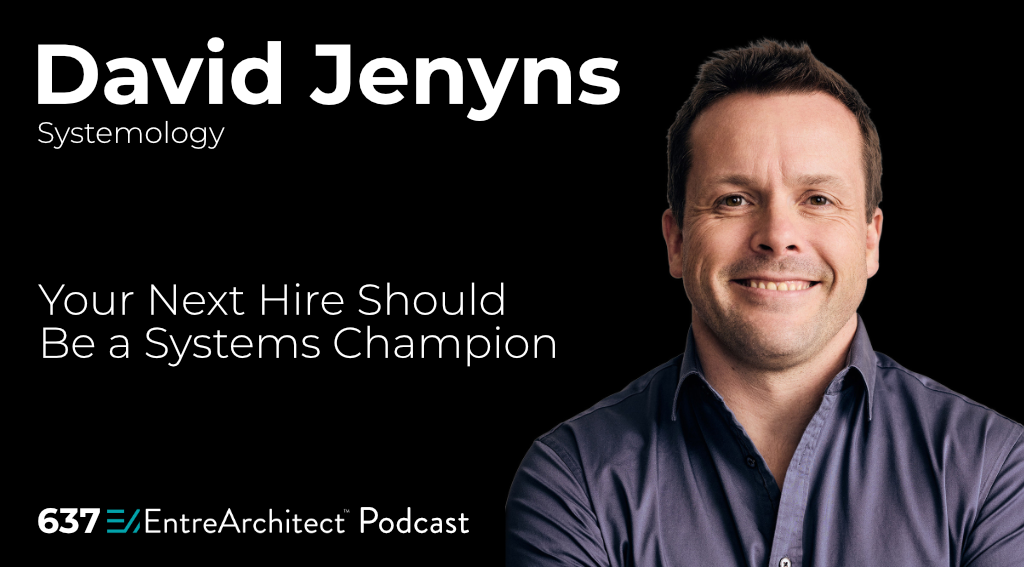
A systems champion might be the most important new hire you make in the next few years. That was my biggest takeaway from my recent conversation with David Jenyns, author of SYSTEMology and the new book Systems Champion. He reminded me that your architecture firm will never truly run without you until someone in your team owns the job of building and maintaining your systems. Not you. Not someday. A specific person with a specific role.
Listen to the full episode at https://entrearchitect.com/637.
Here is what I learned and how I think it applies directly to you as a small firm architect.
Why Your Architecture Firm Feels Like A Prison
David described the moment his own agency started to feel less like a business and more like a trap. He was the expert, the hero, the knight in shining armor. Clients came for him. The work depended on him. If he was not there, the business did not function.
Sound familiar?
Most of us start our firms by being very good at the work. We are the designer, the problem solver, the project lead, the client whisperer. That is how we win the first projects. It is also exactly how we end up boxed in.
The same habits that helped you launch your firm are the habits that keep you stuck in 70 or 80 hour weeks. You step in, you rescue the project, you answer the hard questions, you solve the emergency. Over and over.
David’s turning point came when he found out he and his wife were expecting a baby. He could see his future clearly: he would either keep being the hero and miss that season of life or he would build a business that did not rely on him for every decision and every deliverable.
Architecture firm owners hit the same wall. At some point, you decide you are not willing to trade every evening, every weekend, and every vacation for another set of drawings. That is the moment systems become non-negotiable.
The Mindset Shift: Architect vs Owner
One of David’s most important points was about identity. Architects often see themselves as the architect who does the work, not the owner of an architecture business.
Those are two very different roles.
When your whole identity is wrapped up in being the designer, you will always pull yourself back into the work. You will micromanage. You will re-draw. You will check every note and every dimension. You will tell yourself this project is different and justify why you have to be involved in every step.
But owners think differently. Owners ask questions like:
- How do we want this business to run without me?
- What does the client journey look like from first contact through final payment?
- Which parts of this journey must be me, and which parts could be handled by someone else if there were clear systems?
This is not about ego. It is about choice.
As David put it, freedom is not necessarily about not working. It is about having the freedom to choose how, where, and on what you work.
If you want that freedom, you have to design your firm with the same intentionality you bring to your buildings.
Why Most Architects Struggle To Create Systems
Architects are uniquely gifted and uniquely challenged when it comes to systems. Here is what gets in our way:
- Perfectionism. We are trained to be particular, which makes us reluctant to let others do anything that matters.
- Custom work bias. Every project feels bespoke, so we tell ourselves you cannot systemize this.
- No clear starting point. We know we should have systems, but we do not know what to systemize first.
- No capacity. System development feels important but never urgent, so it rarely gets done.
You probably recognize yourself somewhere in that list. I do.
This is why I got so excited about David’s concept of the systems champion. It solves the capacity problem and gives you a practical path forward without adding more to your plate.
What Is A Systems Champion?
In SYSTEMology, David briefly mentioned a role he called the “systems champion.” As he worked with companies, he saw that firms who actually made progress with systems all had this one role.
The systems champion is the person who:
- Owns the project of documenting how your firm works
- Interviews senior staff and extracts their best practices
- Records tasks being done in real time
- Uses AI tools to turn recordings into checklists and SOPs
- Organizes those systems in a central place
- Builds your “how we do things here” library over time
And here is the key insight: the systems champion is almost never the owner.
You are too busy, too close to the work, and usually wired for creativity and vision, not meticulous documentation. Systems are important, but rarely urgent. That is why they never get done when they depend on you.
Why A Junior Is The Perfect Systems Champion
David has seen systems champions in all shapes and sizes, from part-time parents returning to the workforce to virtual assistants. But for architecture firms, the sweet spot is often a junior team member.
Think of it as an apprentice role.
This is the young architect who:
- Has recently graduated or has a few years of experience
- Understands design and the rhythm of the studio
- Is comfortable with technology and curious about new tools
- Wants to learn how a real practice operates
For them, this is an extraordinary opportunity. Instead of being stuck with only redlines and production tasks, they get access to the entire business. They sit with the project architect, the office manager, and you.
Their job is to understand, document, and improve.
Over time, they become one of the few people in the firm who sees the full picture. They understand how marketing hands off to sales, how projects are set up, how invoices flow, and where things break.
Many grow into operations managers because they learn the business behind the design.
How To Get Started With Systems In Your Firm
Here is a simple plan for putting this idea into action:
- Decide that you want a business that is not dependent on you.
- Hire or appoint a systems champion.
- Give them a framework and a mandate.
- Map the client journey from first contact through final payment.
- Identify the most painful bottleneck and start there.
- Capture what you already do instead of waiting for the perfect system. Record your process, have them observe meetings, and build Version 1.
The goal is not a perfect manual. The goal is visibility and repeatability.
Building Accountability Without Becoming The Systems Police
Systems only work if people use them.
David outlined three excuses teams give:
- I did not know how.
- I did not know it was my responsibility.
- I did not want to.
Your systems champion removes the first two. The third is leadership.
They are not the enforcer. They create clarity. You and your leadership team create accountability. That is how culture forms. Over time, you draw a clear line: this is how we do things here.
Systems, AI, And The Future Of Your Firm
AI is changing everything. Not just how we design, but how we run our practices.
David shared stories of processes that once took hundreds of hours and now take a fraction of the time when AI is built into a clear system.
A systems-driven firm can plug AI into repeatable workflows. A firm without systems will chase tools without real results.
The future is not about AI replacing architects. It is about architects using AI to multiply capacity. Systems make that possible.
Your Next Step
I ended our conversation with my favorite question: What is one thing a small firm architect can do today to build a better business for tomorrow?
His answer: find a systems champion.
Not later. Now.
Decide that your future will not look like your past. Shift from architect to owner. Choose someone in your world who can help build the next version of your firm. Then support them as they build the systems that will give you clarity, capacity, and freedom.
To hear more of David’s insights and stories, listen to the full episode at https://entrearchitect.com/637.
Leave a Reply